Demospongiae |
Suberitida |
Suberitidae
Umwelt: Milieu / Klimazone / Tiefenbereich / Verbreitungsgebiet
Ökologie
Sessile; tiefenbereich 0 - 1100 m (Ref. 119523). Polar
Verbreitung
Territories | FAO Gebiete | Ökosysteme | Vorkommen | Einführungen
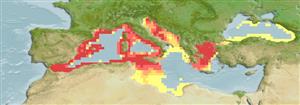
Arctic, Northeast Atlantic and the Mediterranean. Subtropical to polar.
Länge bei der ersten Reifung / Größe / Gewicht / Alter
Geschlechtsreife: Lm ? range ? - ? cm Max length : 10.0 cm WD Männchen/unbestimmt; (Ref. 358)
Sponge of more or less spherical form. Maximum diameter: 10 cm. Smooth surface; comprising only some small channels; often even one and single. Consistency charnue; not very elastic. Variable coloring; of orange to the marbled light blue.
Maximum diameter: 10 cm (Ref. 358). Established on the shells inhabited by the bernards the hermit, and attends primarily the muddy funds and with sandy tendency, more rarely the mattes racinaires of the underwater herbaria. Biology: the species is fixed primarily on the shells inhabited by Paguristes eremita, the Bernard the hermit. The 2 partners being recipients of this association, one will speak about a true symbiosis. This spongiae escapes thus from its condition from sedentary invertebrate, and a mobility acquires which allows him inter alia diffusing its gamètes more widely sexual. Also benefiting from the food of the host, the sponge increases moreover the extent of its food resources. The sponge having covered entirely the shell with the Bernard the hermit, continues his growth by increasing space and by preserving the direction spiral of the shell, the pagure does not need progressively to seek its growth of new refuges. In addition, the spongiae secretes toxic and repulsive substances, which hold predatory shellfish remotely, which, in the final analysis, enjoys a higher protection and a flexible personal habitat (Ref. 358).
Lebenszyklus und Paarungsverhalten
Geschlechtsreife | Fortpflanzung | Ablaichen | Eier | Fruchtbarkeit | Larven
Members of the class Demospongiae are hermaphroditic. Life cycle: The zygote develops into parenchymella larva (free-swimming) before settling down on a substrate where it grows into a young sponge.
Göthel, H. 1992 Guide de la faune sous-marine: La Méditerranée. Invertébrés marins et poissons. Eygen Ulmer GmbH & Co. 318 p. (Ref. 358)
IUCN Rote Liste Status
(Ref. 130435: Version 2025-2 (Global))
CITES Status (Ref. 108899)
Not Evaluated
Not Evaluated
Bedrohung für Menschen
Nutzung durch Menschen
FAO - Publication: search | FishSource |
Tools
Mehr Information
Trophische ÖkologieLebensmittel (Beutetiere)
Nahrungszusammensetzung
Nahrungsaufnahme
Räuber
PopulationsdynamikWachstumMax. Alter/GrößenLänge-Gewicht-Rel.Länge-Länge-Verhältnis.LängenhäufigkeitenMassenkonvertierungDichte LebenszyklusFortpflanzungGeschlechtsreifeFruchtbarkeitAblaichenEierEientwicklungLarven PhysiologieSauerstoffverbrauch
MenschenbezogenBriefmarken, Münzen, Verschiedenes.
Internet Quellen
Schätzungen auf der Grundlage von Modellen
Anfälligkeit der Fischerei
(Ref. 71543) |
Low vulnerability (10 of 100). |
Preiskategorie
(Ref. 80766): |
Unknown. |