Pycnogonida |
Pantopoda |
Pycnogonidae
Umwelt: Milieu / Klimazone / Tiefenbereich / Verbreitungsgebiet
Ökologie
Benthic; tiefenbereich 0 - 1262 m (Ref. 2007). Subtropical; 78°N - 30°N, 72°W - 37°E
Northern Atlantic, Arctic Ocean and the Mediterranean.
Länge bei der ersten Reifung / Größe / Gewicht / Alter
Geschlechtsreife: Lm ? range ? - ? cm
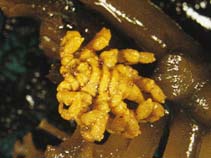
Proboscis: Attached relatively large animals such as actinians or sponges. Cuticle (covering the proboscis): May be smooth, partly, or wholly covered with tubercles. Proboscis (tip): Small and buld-like, once inserted in the host tissues they close round it and help to anchor the mouth in position to maintain suction. Mouth at the tip of the proboscis: triadiate structure which usually has three lip-lobes with a number of small tubercles (Ref. 12). Feeding on hosts: hydroid Tealia crassicornis, by suction and rasping of jaws,Lucernaria, Cucumaria frondosa, Metridiumdianthus and Metridium senile (Ref. 233, 229); polyzoans rotting edges of Flustra foliaces (Ref. 234); Milne-Edwardsia loweni, Tealia crassicornis, Lucernaria, Cucumaria frondosa, Metridium dianthus, Metridium senile, and Cynthia. Method of feeding: insertion of proboscis into tissues of the host (Ref. 233, 229). Association with other animals: Clava multicornis, Actinia, Tealia, Metridium,and Alcyonarium digitatum (Ref. 213); polyzoan Flustra foliacea (Ref. 12). Development site of larval associations: Clava multicornis with proboscis inserted (Ref. 213). Reproduction system: ova ripen in the trunk part of the ovary. Life cycle: male rests for a long period on the back of the female with their genital orifices touching. These orifices are situated on the ventral surface of the second coxa of the last pair of legs in the male and on the dorsal aspect of the same leg and segment in the female. When eggs are released they forma single extensive ball in this species with both ovigerous legs embedded in it (Ref. 12).
Epibenthic (Ref. 87524). Littoral (Ref. 1797) from coastal to slope (Ref. 19). Feeding on hosts, i.e., sea cucumbers, tunicates and hydroids and hard corals (Refs. 229, 233, 234) by inserting proboscis into tissues of the host (Refs. 233 and 229). Free-living (Ref. 3123). Prefers anemones Calliactis sp. and Adamsia sp. over Actinia sp. and Tealia sp. as its host. Reported one case where it fed on the holothurian Cucumaria frondosa (Ref. 121217).
Lebenszyklus und Paarungsverhalten
Geschlechtsreife | Fortpflanzung | Ablaichen | Eier | Fruchtbarkeit | Larven
Reproduction system: ova ripen in the trunk part of the ovary. Life cycle: male rests for a long period on the back of the female with their genital orifices touching. These orifices are situated on the ventral surface of the second coxa of the last pair of legs in the male and on the dorsal aspect of the same leg and segment in the female. When eggs are released they form a single extensive ball in this species with both ovigerous legs embedded in it (Ref. 12).
Bamber, R.N. and M.H. Thurston 1995 The deep-water pycnogonids (Arthropoda, Pycnogonida) of the northeastern Atlantic Ocean. Zoological Journal of the Linnean Society. 115:117-162. (Ref. 1797)
IUCN Rote Liste Status
(Ref. 130435: Version 2025-2 (Global))
CITES Status (Ref. 108899)
Not Evaluated
Not Evaluated
Bedrohung für Menschen
Nutzung durch Menschen
FAO - Publication: search | FishSource |
Tools
Mehr Information
PopulationsdynamikWachstum
Max. Alter/Größen
Länge-Gewicht-Rel.
Länge-Länge-Verhältnis.
Längenhäufigkeiten
Massenkonvertierung
Dichte
LebenszyklusFortpflanzungGeschlechtsreifeFruchtbarkeitAblaichenEierEientwicklungLarven PhysiologieSauerstoffverbrauch
MenschenbezogenBriefmarken, Münzen, Verschiedenes.
Internet Quellen
Schätzungen auf der Grundlage von Modellen
Anfälligkeit der Fischerei
(Ref. 71543) |
(0 of 100). |
Preiskategorie
(Ref. 80766): |
Unknown. |