Pycnogonida |
Pantopoda |
Callipallenidae
Môi trường: môi trường / vùng khí hậu / Mức độ sâu / phạm vi phân phối
Sinh thái học
Benthic; mức độ sâu 27 - 55 m (Tài liệu tham khảo 2115). Tropical
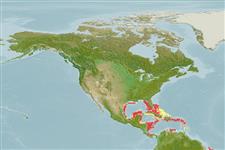
Western Central Atlantic and Indo-West Pacific.
Chiều dài lúc trưởng thành đầu tiên / Bộ gần gũi / Khối lượng (Trọng lượng) / Tuổi
Chín muồi sinh dục: Lm ? range ? - ? cm
Trunk slender, long; neck very long, with few short spines at insertion of chelifores and proboscis. Cephalic segment longer than posterior 3 segments combined; glabrous lateral processes short, little longer than their diameters. Ocular tubercle low, apex with slender, anterior-pointing tubercle; eyes large. Proboscis short, with setose oral fringe. Abdomen short, erect, with 2 short lateral setae. Chelifores short; scapes with 1 long endal spine, several short ectal spines; chelae palms short, rounded, setose; fingers short, with several teeth. Palps lacking. Oviger long; fourth, fifth segments longest, subequal. Strigilis well developed, with denticulate spines and terminal claw. Legs very long, slender, lightly setose; second tibiae longest; propodus straight, with serrate heel spines matching those of tarsus and second tibia; claw robust; auxiliaries more than half main claw length (Ref. 2115, p. 61-62).
Vòng đời và hành vi giao phối
Chín muồi sinh dục | Sự tái sinh sản | Đẻ trứng | Các trứng | Sự sinh sản | Ấu trùng
Members of the class Pycnogonida are gonochoric and sexually dimorphic. During copulation, male usually suspends itself beneath the female. Fertilization occurs as the eggs leave the female's ovigers. Males brood the egg masses until they hatch. Life cycle: Eggs hatch into protonymphon larva then to adults.
King, P.E. 1973 Pycnogonids. Hutchinson of London. London, UK. 144 p. (Tài liệu tham khảo 12)
Tình trạng Sách đỏ IUCN
(Tài liệu tham khảo 130435: Version 2025-2 (Global))
tình trạng CITES (Tài liệu tham khảo 108899)
Not Evaluated
CMS (Tài liệu tham khảo 116361)
Not Evaluated
Mối đe dọa đối với con người
Sử dụng của con người
FAO - Publication: search | FishSource |
Các công cụ
Thêm thông tin
Sinh thái dinh dưỡngThức ăn (con mồi)
Thành phần thức ăn
Thành phần thức ăn
Các động vật ăn mồi
Biến động dân sốSự sinh trưởng
Độ tuổi / kích thước tối đa
Chiều dài-trọng lượng tương đối
Chiều dài-chiều dài tương đối.
Chiều dài-tần số
Chuyển đổi khối lượng
Sự phong phú
Vòng đờiSự tái sinh sảnChín muồi sinh dụcSự sinh sảnĐẻ trứngCác trứngSự phát triển của trứngẤu trùng Sinh lý họcThành phần ô-xy
Liên quan đến con ngườiTem, tiền xu, v.v.
Các nguồn internet
Ước tính dựa trên mô hình
Sự dễ bị tổn thương của nghề đánh cá
(Tài liệu tham khảo 71543) |
(0 of 100). |
Loại giá
(Tài liệu tham khảo 80766): |
Unknown. |