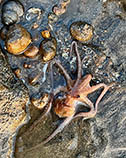
Cephalopoda |
Octopoda |
Octopodidae | Octopodinae
สิ่งแวดล้อม : สิ่งแวดล้อม / เขตภูมิอากาศ / ระดับความลึก / ระยะการกระจายสินค้า
นิเวศวิทยา
Benthic; ระดับความลึก 0 - 50 m (อ้างอิง 275). Tropical; 28°N - 23°S, 35°E - 155°E (อ้างอิง 275)
Indo-West Pacific: from Mozambique to China and the Philippines.
ความยาวเมื่อครบกำหนดครั้งแรก / ขนาด / น้ำหนัก / อายุ
วัยเจริญพันธุ์: Lm ? range ? - ? cm Max length : 100.0 cm TL เพศผู้/กระเทย; (อ้างอิง 96968); น้ำหนักสูงสุดที่มีการรายงาน: 2.0 kg (อ้างอิง 275)
A moderate to large species characterized by: 1) water pouches, 2) an arm formula of I.II.III.IV, 3) a rudimentary ligula without a calamus in males, and 4) little apparent skin sculpture.
It's mantle length is 18 cm (Ref. 96968). It is a bottom-dwelling species, found mainly in intertidal coralline areas (Ref. 128042). Occurs in shallow subtidal areas on soft sediment substrates (Ref. 96968).
วงจรชีวิตและพฤติกรรมการผสมพันธุ์
วัยเจริญพันธุ์ | การสืบพันธุ์ | การวางไข่ | เซลสืบพันธ์ของเพศเมีย(ไข่) | ความดกของไข่ | ตัวอ่อน
Members of the class Cephalopoda are gonochoric. Male and female adults usually die shortly after spawning and brooding, respectively. Mating behavior: Males perform various displays to attract potential females for copulation. During copulation, male grasp the female and inserts the hectocotylus into the female's mantle cavity where fertilization usually occurs. Life cycle: Embryos hatch into planktonic stage and live for some time before they grow larger and take up a benthic existence as adults.
Roper, C.F.E., M.J. Sweeney and C.E. Nauen 1984 FAO Species Catalogue. Vol. 3. Cephalopods of the world. An annotated and illustrated catalogue of species of interest to fisheries. FAO Fish. Synop. 125(3):277p. Rome: FAO. (อ้างอิง 275)
สถานะบัญชีแดงของ IUCN
(อ้างอิง 130435: Version 2025-2 (Global))
สถานะไซเตส (อ้างอิง 108899)
Not Evaluated
CMS (อ้างอิง 116361)
Not Evaluated
ภัยคุกคามต่อมนุษย์
การใช้ของมนุษย์
การประมง: การค้า
FAO - Publication: search | FishSource |
เครื่องมือ
ข้อมูลเพิ่มเติม
นิเวศวิทยาเขตร้อนรายการอาหาร (เหยื่อ)
องค์ประอบของอาหาร
การบริโภคอาหาร
ผู้ล่า
เกี่ยวข้องกับมนุษย์แสตมป์ เหรียญ อื่นๆ
แหล่งที่มาจากอินเตอร์เน็ต
การประมาณค่าตามแบบจำลอง
ความสามารถในการกลับคืนสู่ปกติ
(Ref. 69278): |
ความสูง, เวลาต่ำสุดที่จะทำให้ประชากรเพิ่มขึ้นเป็น 2 เท่าใช้เวลาน้อยกว่า 15 เดือน (K=0.91) |
ความเสี่ยงต่อการตกปลา
(อ้างอิง 71543) |
Low to moderate vulnerability (35 of 100). |
หมวดหมู่ราคา
(อ้างอิง 80766): |
High. |