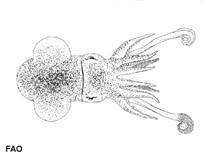
Cephalopoda |
Sepiida |
Sepiolidae | Rossiinae
環境: 環境 / 氣候帶 / 深度上下限 / 配送範圍
生態學
Benthic; 深度上下限 32 - 899 m (參考文獻 1695), usually 200 - 400 m (參考文獻 1695). Temperate; 70°N - 13°N, 33°W - 36°E (參考文獻 1695)
Eastern Atlantic and the Mediterranean: From East Greenland and Iceland to the Mediterranean and northwest Africa. Temperate to polar.
初熟時的長度 / 大小 / 重量 / 年齡
成熟度: Lm ? range ? - ? cm Max length : 10.0 cm ML 雄魚/尚未辨別雌雄; (參考文獻 122093)
Common mantle length: 2.0 to 6.0 cm (Ref. 1695, p. 184). Common mantle length ranges between 2 and 6 cm (Ref. 3722). Hyperbenthic (Ref. 106087). Found over sandy-muddy areas offshore from 32 to 899 m depth. In the western Mediterranean, observed to prefer deeper waters in winter and in shallower coastal waters during spawning and throughout the rest of the year. Polytelic. Spawning takes place throughout the year, peaking in spring and autumn. Mating behavior involves the male grasping the female's 'neck' region followed by the insertion of its hectocotylus into the female's mantle cavity. Eggs are laid in small clusters of 30 to 40, covered with a hard, violet-red coat; commonly found on bivalve shells of Pinna sp. Or on other solid substrates. Eggs hatch after 45 days in water temperature of about 16°C. Females mature at 8 to 11 months and are larger than males that mature at 7 to 8 months. Longevity is approximately 12 months. Of minor commercial importance, mostly as bycatch in bottom trawls, although generally never abundant. Among countries in the Mediterranean, it is variedly valued for its tasty meat and sold fresh or frozen in fish markets (Ref. 1695).
生命週期和交配行為
成熟度 | 繁殖 | 產卵場 | 卵 | 孕卵數 | 仔魚
Members of the class Cephalopoda are gonochoric. Male and female adults usually die shortly after spawning and brooding, respectively. Mating behavior: Males perform various displays to attract potential females for copulation. During copulation, male grasp the female and inserts the hectocotylus into the female's mantle cavity where fertilization usually occurs. Life cycle: Embryos hatch into planktonic stage and live for some time before they grow larger and take up a benthic existence as adults.
主要參考資料
參考文獻 | 合作者 | 合作者
Jereb, P. and C.F.E. Roper (eds.) 2005 Cephalopods of the world. An Annotated and Illustrated catalogue of Cephalopod species known to date. Vol. 1. Chambered nautiluses and sepioids (Nautilidae, Sepiidae, Sepiolidae, Sepiadariidae, Idiosepiidae and Spirulidae). FAO Spec. Cat. Fish. Purp. 4(1):262p. Rome: FAO. (參考文獻 1695)
IUCN 瀕危狀態
(參考文獻 130435: Version 2025-2 (Global))
CITES狀態 (參考文獻 108899)
Not Evaluated
Not Evaluated
對人類具威脅
人類使用
漁業: 低經濟
FAO - Publication: search | FishSource |
工具
網路資源
基於模型的估計
釣魚的脆弱性
(參考文獻 71543) |
Low vulnerability (10 of 100). |
價格種類
(參考文獻 80766): |
Unknown. |