Cephalopoda |
Sepiida |
Sepiolidae | Rossiinae
Môi trường: môi trường / vùng khí hậu / Mức độ sâu / phạm vi phân phối
Sinh thái học
Benthic; mức độ sâu 32 - 899 m (Tài liệu tham khảo 1695), usually 200 - 400 m (Tài liệu tham khảo 1695). Temperate; 70°N - 13°N, 33°W - 36°E (Tài liệu tham khảo 1695)
Eastern Atlantic and the Mediterranean: From East Greenland and Iceland to the Mediterranean and northwest Africa. Temperate to polar.
Chiều dài lúc trưởng thành đầu tiên / Bộ gần gũi / Khối lượng (Trọng lượng) / Tuổi
Chín muồi sinh dục: Lm ? range ? - ? cm Max length : 10.0 cm ML con đực/không giới tính; (Tài liệu tham khảo 122093)
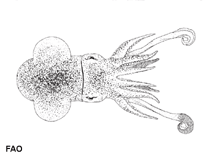
Common mantle length: 2.0 to 6.0 cm (Ref. 1695, p. 184). Common mantle length ranges between 2 and 6 cm (Ref. 3722). Hyperbenthic (Ref. 106087). Found over sandy-muddy areas offshore from 32 to 899 m depth. In the western Mediterranean, observed to prefer deeper waters in winter and in shallower coastal waters during spawning and throughout the rest of the year. Polytelic. Spawning takes place throughout the year, peaking in spring and autumn. Mating behavior involves the male grasping the female's 'neck' region followed by the insertion of its hectocotylus into the female's mantle cavity. Eggs are laid in small clusters of 30 to 40, covered with a hard, violet-red coat; commonly found on bivalve shells of Pinna sp. Or on other solid substrates. Eggs hatch after 45 days in water temperature of about 16°C. Females mature at 8 to 11 months and are larger than males that mature at 7 to 8 months. Longevity is approximately 12 months. Of minor commercial importance, mostly as bycatch in bottom trawls, although generally never abundant. Among countries in the Mediterranean, it is variedly valued for its tasty meat and sold fresh or frozen in fish markets (Ref. 1695).
Vòng đời và hành vi giao phối
Chín muồi sinh dục | Sự tái sinh sản | Đẻ trứng | Các trứng | Sự sinh sản | Ấu trùng
Members of the class Cephalopoda are gonochoric. Male and female adults usually die shortly after spawning and brooding, respectively. Mating behavior: Males perform various displays to attract potential females for copulation. During copulation, male grasp the female and inserts the hectocotylus into the female's mantle cavity where fertilization usually occurs. Life cycle: Embryos hatch into planktonic stage and live for some time before they grow larger and take up a benthic existence as adults.
Jereb, P. and C.F.E. Roper (eds.) 2005 Cephalopods of the world. An Annotated and Illustrated catalogue of Cephalopod species known to date. Vol. 1. Chambered nautiluses and sepioids (Nautilidae, Sepiidae, Sepiolidae, Sepiadariidae, Idiosepiidae and Spirulidae). FAO Spec. Cat. Fish. Purp. 4(1):262p. Rome: FAO. (Tài liệu tham khảo 1695)
Tình trạng Sách đỏ IUCN
(Tài liệu tham khảo 130435: Version 2025-2 (Global))
tình trạng CITES (Tài liệu tham khảo 108899)
Not Evaluated
CMS (Tài liệu tham khảo 116361)
Not Evaluated
Mối đe dọa đối với con người
Sử dụng của con người
Các nghề cá: buôn bán nhỏ
FAO - Publication: search | FishSource |
Các công cụ
Thêm thông tin
Vòng đờiSự tái sinh sảnChín muồi sinh dụcSự sinh sảnĐẻ trứngCác trứngSự phát triển của trứngẤu trùng Sinh lý họcThành phần ô-xy
Liên quan đến con ngườiTem, tiền xu, v.v.
Các nguồn internet
Ước tính dựa trên mô hình
Sự dễ bị tổn thương của nghề đánh cá
(Tài liệu tham khảo 71543) |
Low vulnerability (10 of 100). |
Loại giá
(Tài liệu tham khảo 80766): |
Unknown. |