Cephalopoda |
Oegopsida |
Ommastrephidae | Todarodinae
Lingkungan: lingkungan / zona iklim / kisaran kedalaman / jangkauan distribusi
Ekologi
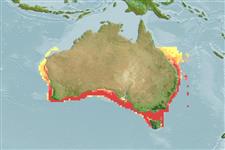
Pelagic-oceanic; kisaran kedalaman 0 - 700 m (Acuan 275), usually 50 - 300 m (Acuan 8121). Subtropical; 19°S - 43°S, 109°E - 157°E (Acuan 275)
Indo-West Pacific: Australia and New Zealand. Subtropical to temperate.
Panjang pada saat jatuh tempo pertama / Ukuran / Berat / umur
Kematangan: Lm ? range ? - ? cm Max length : 35.0 cm ML jantan/; (Acuan 275); 40 cm ML (female); Berat maksimum terpublikasi: 800.00 g (Acuan 275)
Females grow larger than males (Ref. 3722). Maximum depth from Ref. 8121. Minimum common depth from Ref. 121690. Neritic and oceanic species (Ref. 121690). Mostly inhabits waters <500 m in depth on the continental shelf and slope (Ref. 121690). Common in the continental shelf and sometimes can even enter shallow waters and estuaries, particularly during summer (Ref. 121673). Most abundant near the shelf-break front or where other mesoscale oceanographic activity is present. Mature squid may be restricted to deeper offshore waters for successful spawning (Ref. 121689). Feeds on ommastrephid squids, fishes (primarily pilchards; Ref. 275).
Siklus hidup dan perilaku kawin
Kematangan | Reproduksi, perkembang biakan | Pemijahan | telur-telur | Fekunditas | Larva
Members of the class Cephalopoda are gonochoric. Male and female adults usually die shortly after spawning and brooding, respectively. Mating behavior: Males perform various displays to attract potential females for copulation. During copulation, male grasp the female and inserts the hectocotylus into the female's mantle cavity where fertilization usually occurs. Life cycle: Embryos hatch into planktonic stage and live for some time before they grow larger and take up a benthic existence as adults.
rujukan utama
Acuan | Koordinator | mitra
Roper, C.F.E., M.J. Sweeney and C.E. Nauen 1984 FAO Species Catalogue. Vol. 3. Cephalopods of the world. An annotated and illustrated catalogue of species of interest to fisheries. FAO Fish. Synop. 125(3):277p. Rome: FAO. (Acuan 275)
Status IUCN Red List
(Acuan 130435: Version 2025-2 (Global))
status CITES (Acuan 108899)
Not Evaluated
Not Evaluated
ancaman kepada manusia
penggunaan manusia
Perikanan: komersial
FAO - Publication: search | FishSource |
Alat, peralatan
informasi lanjut
Dinamika populasiPertumbuhan
Maks. usia / ukuran
Panjang-berat rel.
Panjang-panjang rel.
ukuran frekuensi
Konversi massa
Kelimpahan
FisiologiKonsumsi oksigen
Yang berhubungan dengan manusiaPerangko, koin, dll.
Sumber internet
Estimasi berdasarkan model
Kerentanan Penangkapan Ikan
(Acuan 71543) |
Low to moderate vulnerability (30 of 100). |
kategori harga
(Acuan 80766): |
Medium. |