Cephalopoda |
Oegopsida |
Ommastrephidae | Todarodinae
Environnement : milieu / zone climatique / profondeur / gamme de distribution
Écologie
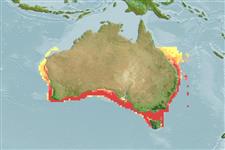
Pelagic-oceanic; profondeur 0 - 700 m (Réf. 275), usually 50 - 300 m (Réf. 8121). Subtropical; 19°S - 43°S, 109°E - 157°E (Réf. 275)
Indo-West Pacific: Australia and New Zealand. Subtropical to temperate.
Longueur à la première maturité / Taille / Poids / Âge
Maturité: Lm ? range ? - ? cm Max length : 35.0 cm ML mâle / non sexé; (Réf. 275); 40 cm ML (female); poids max. publié: 800.00 g (Réf. 275)
Females grow larger than males (Ref. 3722). Maximum depth from Ref. 8121. Minimum common depth from Ref. 121690. Neritic and oceanic species (Ref. 121690). Mostly inhabits waters <500 m in depth on the continental shelf and slope (Ref. 121690). Common in the continental shelf and sometimes can even enter shallow waters and estuaries, particularly during summer (Ref. 121673). Most abundant near the shelf-break front or where other mesoscale oceanographic activity is present. Mature squid may be restricted to deeper offshore waters for successful spawning (Ref. 121689). Feeds on ommastrephid squids, fishes (primarily pilchards; Ref. 275).
Cycle de vie et comportement reproducteur
Maturité | Reproduction | Frai | Œufs | Fécondité | Larves
Members of the class Cephalopoda are gonochoric. Male and female adults usually die shortly after spawning and brooding, respectively. Mating behavior: Males perform various displays to attract potential females for copulation. During copulation, male grasp the female and inserts the hectocotylus into the female's mantle cavity where fertilization usually occurs. Life cycle: Embryos hatch into planktonic stage and live for some time before they grow larger and take up a benthic existence as adults.
Roper, C.F.E., M.J. Sweeney and C.E. Nauen 1984 FAO Species Catalogue. Vol. 3. Cephalopods of the world. An annotated and illustrated catalogue of species of interest to fisheries. FAO Fish. Synop. 125(3):277p. Rome: FAO. (Réf. 275)
Statut dans la liste rouge de l'IUCN
(Réf. 130435: Version 2025-2 (Global))
statut CITES (Réf. 108899)
Not Evaluated
Not Evaluated
Menace pour l'homme
Utilisations par l'homme
Pêcheries: commercial
FAO - Publication: search | FishSource |
Outils
Plus d'informations
Dynamique des populationsCroissance
Âges / tailles maximales
Longueur-poids rel.
Rel. longueur-longueur.
Fréquences de longueurs
Conversion de masse
Abondance
Cycle de vieReproductionMaturitéFéconditéFraiŒufsDéveloppement de l'œufLarves PhysiologieConsommation d'oxygène
Liées à l'hommeTimbres, pièces de monnaie, divers
Sources Internet
Estimations basées sur des modèles
Vulnérabilité de la pêche
(Réf. 71543) |
Low to moderate vulnerability (30 of 100). |
Catégorie de prix
(Réf. 80766): |
Medium. |