
Thysanoteuthis rhombus, Rhomboid squid : fisheries
Advertisement

You can sponsor this page

Thysanoteuthis rhombus   Troschel, 1857

Rhomboid squid

Native range | All suitable habitat | Point map | Year 2050
This map was computer-generated and has not yet been reviewed.
Thysanoteuthis rhombus  AquaMaps  Data sources: GBIF OBIS
アップロード 写真 
全ての写真 | グーグルの画像 |
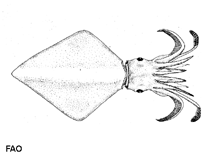
Image of Thysanoteuthis rhombus (Rhomboid squid)
Thysanoteuthis rhombus
Picture by FAO

分類 / 名前 共通名の | 類義語 | CoL | ITIS | WoRMS

Cephalopoda | Oegopsida | Thysanoteuthidae

環境:環境 / 気候帯 / 深さの範囲 / 分布範囲 生態学

外洋の; 深さの範囲 0 - 2604 m (参照 83938).  Tropical; 20°C - 26°C (参照 95878); 51°N - 42°S, 180°W - 180°E (参照 107076)

分布 Territories | 国連食糧農業機関の区域 | エコシステム | 事件 | 導入

Circumglobal in tropical and subtropical waters.

初回成熟時の長さ / サイズ / 重さ / 年齢

成熟: Lm 60.0, range 55 - 65 cm Max length : 130 cm ML オス/雌雄の選別がない; (参照 104052); common length : 60.0 cm ML オス/雌雄の選別がない; (参照 417); 最大公表体重: 30.0 kg (参照 97142)

生物学     用語集 (例 表在性)

Caught with set nets and drifting jigs (Ref. 417). Maximum mantle length of both sexes is the same, 100 cm, possibly to 130 cm (Ref. 97142). Maximum depth from Ref. 104455. An oceanic species (Ref. 83938), only rarely approaches the shelf zone (Ref. 122970). Occupies epipelagic to upper mesopelagic depths, and undergoes diel vertical migrations. Cosmopolitan, common circumglobal inhabitant of warm tropical and subtropical open waters, only rarely approaching the shelf zone (Ref. 97142). Occurs in a front (Ref. 122966). Avoids the oligotrophic central waters of the open ocean. Also reaches higher latitudes into temperate boreal and notalian regions, transported by warm currents, e.g. the Tsushima, Kuroshio, Agulhas, Brazil Currents and the Gulf Stream. Not an active swimmer during most of its life cycle, rather, it propels itself slowly by gentle undulation of its long, broad, diamond-shaped fins. However, is capable of a powerful reactive jet of short duration when threatened. Such low-energy life style promotes very high growth rates, among the highest of all squids. By the age of 300 days, may reach 800 mm mantle length and 17.5 kg body weight. Males reach maturity mainly at 400 to 550 mm mantle length (age 170 to 200 days), and females mature at 550 to 650 mm mantle length (age 230 to 250 days). Life span is 1 year. Spawning lasts throughout the year in tropical waters and during the warm season in peripheral regions. Spawning is intermittent, with multiple fillings and evacuations of the oviducts. Mating occurs in the "head to head" position. The social organization is unique among squids: consists of pairs formed of same-sized males and females that occur at an immature stage of less than 100 mm mantle length, and probably remain together constantly during their lifetimes (monogamy). Small schools of pairs may be locally common. Arm length and probably the anal photophore play the key role in pair formation in immature squids. Juveniles feed on crustaceans, small cephalopods and fishes in subsurface waters, but subadults and adults feed mainly in daytime in deep-water layers mostly from 400 to 650 m on dense concentrations of non-active midwater fishes. Predators include different species of ommastrephid squids, dolphin fish, lancet fish, various species of tuna, swordfish, Gempylus serpens, sharks and mammals (e.g. dolphins, rough-toothed dolphin, false killer whale, sperm whale). Valued for its firm and flavorful flesh, its high commercial value makes it an important target species along the coastal waters of the Sea of Japan and around Okinawa (Ref. 97142).

ライフサイクルと交尾行動 成熟 | 繁殖 | 放精 | | 生産力 | 幼生

During copulation, female and male mate in a head-to-head position. The male transfers its spermatophores to the female via the hectocotylus, which attaches to the surface of the female's buccal membrane. Spawning occurs throughout the year, in tropical waters during summer and early autumn, and lasts for 2-3 months. During spawning, females first produce a secretion of the nidamental glands like that of the ommastrephid Todarodespacificus. The secretion enters the water, and swells, and the female molds it into a cylinder. After that, the oviductal glands start to work, forming 2 mucous threads, each with 1 row of eggs. In the mantle cavity both threads fuse and develop into a single cord containing a double row of eggs. This cord exits into the water through the funnel, and the eggs are fertilized with spermatozoa from seminal receptacles located in the female's buccal membrane. The female then winds the cord of eggs onto the cylinder. As a result, the structure of the egg mass is uniform, as observed in natural egg masses of T. rhombus (Ref. 95878).

主な参考文献 参考文献 | コーディネーター | 協力者

Schneider, W. 1990 FAO species identification sheets for fishery purposes. Field guide to the commercial marine resources of the Gulf of Guinea. Prepared and published with the support of the FAO Regional Office for Africa. Rome: FAO. 268 p. (参照 417)

IUCNのレッドリストの状況は (参照 130435: Version 2025-2 (Global))

  軽度懸念 (LC) ; Date assessed: 11 May 2010

ワシントン条約ステータス (参照 108899)

Not Evaluated

CMS (参照 116361)

Not Evaluated

人間に対する脅威

人間の用途

水産業: 商業
FAO - Publication: search | FishSource |

用具

より多くの情報

生態学
人口動態
成長
最大年齢/サイズ
長さ-重量比。
長短関係。
体長組成
質量変換
豊度
ライフサイクル
繁殖
成熟
生産力
放精

卵の開発
幼生
生理学
酸素消費
人間関係
切手、コイン、その他
アウトリーチ
分類学
参考文献

インターネットの情報源

BHL | BOLD Systems | CISTI | DiscoverLife | FAO - Publication: search | Fishipedia | GenBank (ゲノム, ヌクレオチド) | GloBI | Gomexsi | Google Books | Google Scholar | Google | PubMed | 生命の木 | Wikipedia (行く, 検索する) | 動物に関する記録

モデルに基づく推定値

回復力
(Ref. 69278):
高い, 15か月以下の倍増期間の最小個体群 (K=0.84; tm=0.68)
漁業の脆弱性
(参照 71543)
Moderate vulnerability (38 of 100).
価格帯
(参照 80766):
Medium.