Cephalopoda |
Octopoda |
Argonautidae
Environnement : milieu / zone climatique / profondeur / gamme de distribution
Écologie
Pélagique; profondeur 0 - 200 m (Réf. 83938). Tropical; 50°N - 42°S, 180°W - 180°E (Réf. 275)
Circumglobal in tropical and warm temperate seas.
Longueur à la première maturité / Taille / Poids / Âge
Maturité: Lm ? range ? - ? cm Max length : 72.6 cm TL (female)
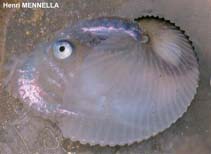
Maximum total length: male, 1.5 to 2.0 cm. Maximum length of shell, 30 cm in females; males are of dwarf size, only 1.5 to 2 cm in total length (Ref. 275). Maximum total length 72.6 cm, and mantle length 14.14 cm for females (122434). Epipelagic (Ref. 83938). Females use the shell to trap air, gathered at the sea surface, to attain neutral buoyancy (Ref. 96968). Few shells found washed up on beaches (Ref. 88739).
Cycle de vie et comportement reproducteur
Maturité | Reproduction | Frai | Œufs | Fécondité | Larves
On contact with the female, it is presumed that the male autotomizes the hectocotylus. Multiple hectocotyli can persist in shells and mantle cavities of females for extended periods. Eggs of up to five different developmental stages may be present within a single shell (Ref. 96968). Females inhabit the shell of Nautilus for egg deposition and brooding (Ref. 98241).
Roper, C.F.E., M.J. Sweeney and C.E. Nauen 1984 FAO Species Catalogue. Vol. 3. Cephalopods of the world. An annotated and illustrated catalogue of species of interest to fisheries. FAO Fish. Synop. 125(3):277p. Rome: FAO. (Réf. 275)
Statut dans la liste rouge de l'IUCN
(Réf. 130435: Version 2025-2 (Global))
statut CITES (Réf. 108899)
Not Evaluated
Not Evaluated
Menace pour l'homme
Utilisations par l'homme
Pêcheries: commercial
FAO - Publication: search | FishSource |
Outils
Plus d'informations
Dynamique des populationsCroissanceÂges / tailles maximalesLongueur-poids rel.Rel. longueur-longueur.Fréquences de longueursConversion de masseAbondance PhysiologieConsommation d'oxygène
Liées à l'hommeTimbres, pièces de monnaie, divers
Sources Internet
Estimations basées sur des modèles
Vulnérabilité de la pêche
(Réf. 71543) |
Moderate to high vulnerability (49 of 100). |
Catégorie de prix
(Réf. 80766): |
Unknown. |