Polyplacophora |
Chitonida |
Mopaliidae
Environnement : milieu / zone climatique / profondeur / gamme de distribution
Écologie
Benthic; profondeur 0 - 100 m (Réf. 289). Temperate
Northeast Pacific, Atlantic ocean and Arctic Ocean: Alaska and USA. Temperate to polar.
Longueur à la première maturité / Taille / Poids / Âge
Maturité: Lm ? range ? - ? cm Max length : 6.0 cm TL mâle / non sexé; (Réf. 289)
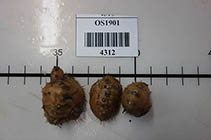
Depth: Intertidal to 100 m. Habitat: On rocks (Ref. 289). Body: Oval; with the valves nearly covered by a brown skin continued upward from the girdle, but their outlines are plainly visible through this integument. Small exposed portion of each median valve: Broadly heart-shaped and situated at the posterior margin of each valve; it is sculptured with strong concentric grooves and a more or less distinct granulation. Girdle: Thin, smooth with sparsely scattered small bunches of hairs (Ref. 297). Known to occur on bathyal, infralittoral and circalittoral of the Gulf and estuary (Ref. 87872).
Cycle de vie et comportement reproducteur
Maturité | Reproduction | Frai | Œufs | Fécondité | Larves
Sexes are separate but they are indistinguishable externally. Fertilization is external and usually the eggs are shed into the water.
Burghardt, G. and L. Burghardt 2006 West Coast Chitons. A Gallery of Worlwide Chitons: http://home.inreach.com/burghart/wcoast.html[accessed20/01/06] (Réf. 296)
Statut dans la liste rouge de l'IUCN
(Réf. 130435: Version 2025-2 (Global))
statut CITES (Réf. 108899)
Not Evaluated
Not Evaluated
Menace pour l'homme
Utilisations par l'homme
FAO - Publication: search | FishSource |
Outils
Plus d'informations
Écologie trophiqueAliments (proies)
Composition du régime alimentaire
Consommation alimentaire
Prédateurs
Dynamique des populationsCroissance
Âges / tailles maximales
Longueur-poids rel.
Rel. longueur-longueur.
Fréquences de longueurs
Conversion de masse
Abondance
Cycle de vieReproductionMaturitéFéconditéFraiŒufsDéveloppement de l'œufLarves PhysiologieConsommation d'oxygène
Liées à l'hommeTimbres, pièces de monnaie, divers
Sources Internet
Estimations basées sur des modèles
Vulnérabilité de la pêche
(Réf. 71543) |
Low vulnerability (10 of 100). |
Catégorie de prix
(Réf. 80766): |
Unknown. |