Not assigned |
Squamata |
Elapidae
Miljö: miljö / Klimatzon / djupintervall / distributionsområde
Ekologi
Revassocierade; djupintervall 0 - 10 m (Ref. 78651). Tropical; 49°N - 58°S (Ref. 356)
Indo-Pacific and the Atlantic: from the Bay of Bengal and Taiwan to Australia and the islands of Oceania.
Längd vid första mognad / Storlek / Vikt / Ålder
Könsmognad: Lm ? range ? - ? cm Max length : 150 cm TL hane/ej könsbestämd; (Ref. 88066)
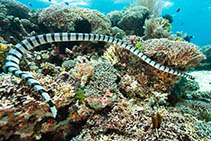
Moderately built. Black cross bands completely encircle the bluish body. Black head with yellow snout and upper lip, yellow bar extending from the eye to the temporal region (Ref. 2357).
It is found in fringing reefs and is observed to rest on rock crevices near the water edge (Ref. 88090). Also found in the open ocean, in mangroves and coral islands, usually in shallow waters (Ref. 98471). Emerges from rocks to feed in the sea (Ref. 75610). Forages on eels in shallow coastal waters and goes back to land to slough and digest its prey (Ref. 98471). Exhibits sex divergence in dietary habits, wherein adult females feed mainly on large conger eels and take only a single prey item while adult males feed on smaller moray eels and constantly ingest multiple prey items (Ref. 74654). It seeks shelter in vegetation, beneath rocks, within crevices and caves on land (Ref. 98471). Also found along the roads and some low mountains (Ref. 2355). More terrestrial in habits than Laticauda laticaudata, its congener (Ref. 98471).
Livscykel och parningsbeteende
Könsmognad | Reproduktion | Lek | Ägg | Fekunditet | Larver
Mating is observed on shore and a clutch of up to 10 eggs is deposited in crevices (Ref. 88090).
Mao, S. and B. Chen 1980 Sea Snakes of Taiwan: A natural history of sea snakes. The National Science Council. NSC Publication No. 4. v-57pp. (Ref. 75711)
Status på IUCN:s rödlista
(Ref. 130435: Version 2025-2 (Global))
CITES-status (Ref. 108899)
Not Evaluated
Not Evaluated
Hot mot människor
Mänskliga användningsområden
FAO - Publication: search | FishSource |
Verktyg
Ytterligare information
LivscykelReproduktionKönsmognadFekunditetLekÄggUtveckling av äggLarver MänniskorelateradFrimärken, mynt, diverse.
Internet-källor
Uppskattningar baserade på modeller
Resiliens
(Ref. 69278): |
Hög, lägsta populationsfördubblingstid mindre än 15 månader (K=0.25-0.88) |
Sårbarhet i fisket
(Ref. 71543) |
High to very high vulnerability (66 of 100). |
Priskategori
(Ref. 80766): |
Unknown. |