Aves |
Charadriiformes |
Alcidae
Umwelt: Milieu / Klimazone / Tiefenbereich / Verbreitungsgebiet
Ökologie
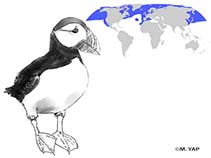
Others; tiefenbereich 0 - 60 m (Ref. 62202), usually 20 - 30 m (Ref. 62202). Polar; 83°N - 24°N, 85°W - 71°E (Ref. 124582)
Arctic, Northern Atlantic and the Mediterranean. Boreal to polar.
Länge bei der ersten Reifung / Größe / Gewicht / Alter
Geschlechtsreife: Lm ? range ? - ? cm Max length : 30.0 cm TL Männchen/unbestimmt; (Ref. 8812); max. veröff. Gewicht: 381.00 g (Ref. 356)
Culmen: 4.56 cm; tarsus: 2.88 cm; wing: 17.21 cm.
Total Length: 28 to 30 cm; Wingspan: 53 to 58 cm (Ref. 8812). Occupy the continental shelf; <100 km; exhibits plunge-diving feeding behavior (Ref. 356). In the North Sea off the east coast of Scotland and northern England, this species is known to feed on the sandeel, Ammodytes marinus and breeding birds spend approx. 80% of daylight period at sea, commonly in dense rafts. They form nesting colonies with breeding pairs sharing incubation and chick-rearing duties; surface-feeding by scooping prey from the water, they carry prey in their bills and feed their chicks with regurgitated food (Ref. 95711).
Lebenszyklus und Paarungsverhalten
Geschlechtsreife | Fortpflanzung | Ablaichen | Eier | Fruchtbarkeit | Larven
Barrett, R.T. and F. Rikardsen 1992 Chick growth, fledging periods and adult mass loss of Atlantic Puffins Fratercula arctica during years of prolonged food stress. Colonial Waterbirds 15(1):24-32. (Ref. 4091)
IUCN Rote Liste Status
(Ref. 130435: Version 2025-2 (Global))
CITES Status (Ref. 108899)
Not Evaluated
Not Evaluated
Bedrohung für Menschen
Nutzung durch Menschen
FAO - Publication: search | FishSource |
Tools
Mehr Information
PopulationsdynamikWachstumMax. Alter/GrößenLänge-Gewicht-Rel.Länge-Länge-Verhältnis.LängenhäufigkeitenMassenkonvertierungDichte LebenszyklusFortpflanzungGeschlechtsreifeFruchtbarkeitAblaichenEierEientwicklungLarven PhysiologieSauerstoffverbrauch
MenschenbezogenBriefmarken, Münzen, Verschiedenes.
Internet Quellen
Schätzungen auf der Grundlage von Modellen
Widerstandsfähigkeit
(Ref. 69278): |
hoch, Verdopplung der Population dauert weniger als 15 Monate. (K=8.27-39.05) |
Anfälligkeit der Fischerei
(Ref. 71543) |
Low vulnerability (20 of 100). |
Preiskategorie
(Ref. 80766): |
Unknown. |