Gastropoda |
Nudibranchia |
Discodorididae
Umwelt: Milieu / Klimazone / Tiefenbereich / Verbreitungsgebiet
Ökologie
Benthic; tiefenbereich 0 - 229 m (Ref. 822). Subtropical
Eastern Pacific. Tropical to temperate.
Länge bei der ersten Reifung / Größe / Gewicht / Alter
Geschlechtsreife: Lm ? range ? - ? cm Max length : 20.0 cm TL Männchen/unbestimmt; (Ref. 822); common length : 8.0 cm TL Männchen/unbestimmt; (Ref. 312)
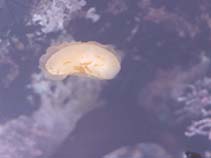
Body is oval. Coarse bumps called tubercles cover the body. It is orange-yellow to light yellow with dark brown to black blotches between bumps on its back. Gill plume is white and near the rear end. It has a fruity odor that seems to discourage predators.
Assumed maximum length from Ref. 822. Habitat: Found in the low intertidal to subtidal zone. Diet: sponges and detritus (Ref. 312).
Lebenszyklus und Paarungsverhalten
Geschlechtsreife | Fortpflanzung | Ablaichen | Eier | Fruchtbarkeit | Larven
Members of the order Nudibranchia are simultaneous hermaphrodites. Mating behavior: Both individuals darts their penis toward each other to induce one to act as a male and the other as the female. The victorious one to penetrate the body wall is the dominant male. Life cycle: Eggs are deposited on a substratum where they develop and hatch into (planktonic) vestigial veliger larval stage and further grow as adults.
Gallivan, G. and J. Danforth 1999 Phylum Mollusca. Marine Science Institute. (Ref. 312)
IUCN Rote Liste Status
(Ref. 130435: Version 2025-2 (Global))
CITES Status (Ref. 108899)
Not Evaluated
Not Evaluated
Bedrohung für Menschen
Nutzung durch Menschen
FAO - Publication: search | FishSource |
Tools
Mehr Information
Trophische ÖkologieLebensmittel (Beutetiere)
Nahrungszusammensetzung
Nahrungsaufnahme
Räuber
PopulationsdynamikWachstum
Max. Alter/Größen
Länge-Gewicht-Rel.
Länge-Länge-Verhältnis.
Längenhäufigkeiten
Massenkonvertierung
Dichte
LebenszyklusFortpflanzungGeschlechtsreifeFruchtbarkeitAblaichenEierEientwicklungLarven PhysiologieSauerstoffverbrauch
MenschenbezogenBriefmarken, Münzen, Verschiedenes.
Internet Quellen
Schätzungen auf der Grundlage von Modellen
Anfälligkeit der Fischerei
(Ref. 71543) |
Low vulnerability (10 of 100). |
Preiskategorie
(Ref. 80766): |
Unknown. |