Bivalvia |
Myida |
Teredinidae
Environnement : milieu / zone climatique / profondeur / gamme de distribution
Écologie
Benthic. Subtropical
Indo-Pacific.
Longueur à la première maturité / Taille / Poids / Âge
Maturité: Lm ? range ? - ? cm
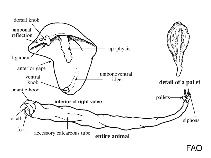
May reach a length of 155 cm and a diameter of 6 cm. Found intertidal in mangrove mud (Ref. 53). Giant bivalve that burrows in black, organic-rich sediments in a marine bay, setting it apart from wood-boring shipworms. Descended from wood-feeding ancestors. Feeds by harboring sulfur-oxidizing chemoautotrophic (thioautotrophic) bacteria in contrast with other shipworms which use cellulolytic symbionts to obtain nutrition from decaying wood (Ref. 114919).
Cycle de vie et comportement reproducteur
Maturité | Reproduction | Frai | Œufs | Fécondité | Larves
Members of the class Bivalvia are mostly gonochoric, some are protandric hermaphrodites. Life cycle: Embryos develop into free-swimming trocophore larvae, succeeded by the bivalve veliger, resembling a miniature clam.
Bernard, F.R., Y.Y. Cai and B. Morton 1993 Catalogue of the living marine bivalve molluscs of China. Hong Kong University Press, Hong Kong. 121 p. (Réf. 75831)
Statut dans la liste rouge de l'IUCN
(Réf. 130435: Version 2025-2 (Global))
statut CITES (Réf. 108899)
Not Evaluated
Not Evaluated
Menace pour l'homme
Utilisations par l'homme
FAO - Publication: search | FishSource |
Outils
Plus d'informations
Écologie trophiqueAliments (proies)
Composition du régime alimentaire
Consommation alimentaire
Prédateurs
Dynamique des populationsCroissance
Âges / tailles maximales
Longueur-poids rel.
Rel. longueur-longueur.
Fréquences de longueurs
Conversion de masse
Abondance
Cycle de vieReproductionMaturitéFéconditéFraiŒufsDéveloppement de l'œufLarves PhysiologieConsommation d'oxygène
Liées à l'hommeTimbres, pièces de monnaie, divers
Sources Internet
Estimations basées sur des modèles
Vulnérabilité de la pêche
(Réf. 71543) |
(0 of 100). |