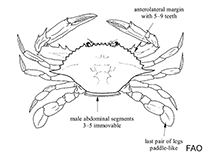
Malacostraca |
Decapoda |
Portunidae
Environnement : milieu / zone climatique / profondeur / gamme de distribution
Écologie
Benthic; profondeur ? - 439 m (Réf. 118320). Subtropical
Indo-West Pacific: from the east coast of India; to Japan, south to Australia.
Longueur à la première maturité / Taille / Poids / Âge
Maturité: Lm ? range ? - ? cm Max length : 3.4 cm CW mâle / non sexé; (Réf. 125642); 2.075 cm CL (female)
Predominantly found in inner bays, living on sandy bottoms from the intertidal to a depth of 439 m (Ref. 118320). Also found in silt-clay sediments (Ref. 118321) and among seagrass in shallow waters (Ref. 125642).
Cycle de vie et comportement reproducteur
Maturité | Reproduction | Frai | Œufs | Fécondité | Larves
Members of the order Decapoda are mostly gonochoric. Mating behavior: Precopulatory courtship ritual is common (through olfactory and tactile cues); usually indirect sperm transfer.
Chen, D., Q. Liu, X. Zeng and Z. Su 1997 Catch composition and seasonal variation of setnet fisheries in the Yellow and Bohai Seas. Fisheries Reserch 32:61-68. (Réf. 77881)
Statut dans la liste rouge de l'IUCN
(Réf. 130435: Version 2025-2 (Global))
statut CITES (Réf. 108899)
Not Evaluated
Not Evaluated
Menace pour l'homme
Utilisations par l'homme
FAO - Publication: search | FishSource |
Outils
Plus d'informations
Dynamique des populations PhysiologieConsommation d'oxygène
Liées à l'hommeTimbres, pièces de monnaie, divers
Sources Internet
Estimations basées sur des modèles
Résilience
(Ref. 69278): |
Haut, temps minimum de doublement de population inférieur à 15 mois (K=1.78-1.94) |
Vulnérabilité de la pêche
(Réf. 71543) |
Low vulnerability (10 of 100). |