Holothuroidea |
Holothuriida |
Holothuriidae
Milieu: milieu / Klimaatzone / Diepte / verspreidingsgebied
Ecologie
Rifbewoner; diepte 0 - 35 m (Ref. 122), usually 1 - 3 m (Ref. 92930). Tropical; 32°N - 36°S, 30°E - 124°W
Indo-Pacific.
Lengte bij maturiteit / Grootte / Gewicht / Leeftijd
Maturiteit: Lm ?, range 22 - ? cm Max length : 35.0 cm TL mannelijk / geslacht onbekend; (Ref. 122); common length : 20.0 cm TL mannelijk / geslacht onbekend; (Ref. 122); max. gepubliceerd gewicht: 1.5 kg (Ref. 104244)
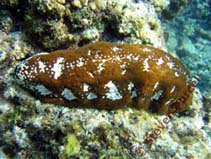
Maximum width: 10 cm (Ref. 418). Body wall thickness: 0.6 cm. Body elongate, arched dorsally (bivium and flattened ventrally (trivium). Bivium sometimes wrinkled; wider in the middle; and tapering towards both ends. Papillae on bivium long and slender. Podia numerous on trivium, stout and crowded on the radii and interadii; calcareous disc of podia around 500 micrometer in diameter. Mouth ventral, surrounded by 25 short and stout tentacles, with a large collar of long papillae at their base. Anus surrounded by 25 stout anal teeth. Calcareous ring showing large radial pieces and interradials with triangular top. Cuvierian tubules few (10), short pink, and never expelled. Color of bivium variable, usually dark brown, with more or less distinct whitish spots. Trivium grains, rods bearing small spines, and denticulate pseudo-plates; dorsal tegument without grains, but with rosettes and denticulate rods; podia with some spinous rods and large rosettes. Tentacles with large rods bearing small spines.
Maximum depth from Ref. 122570'>122570. Harvested by artisanal fisheries throughout the Western Central Pacific, but probably less frequently than other species of Actinopyga. Collected by hand while wading on the reef at low tide. Processed product is not distinguished from those of other Actinopyga species; moderate commercial value. Prefers coral habitats (Ref. 122152'>122152). Dwelling in very shallow waters, rarely found in depths of more than 20 m; mostly on outer reef flats of barrier reefs and fringing reefs exposed to strong hydrodynamism (Ref. 122). In subtidal reefs (Ref. 99447) and sandy lagoons (Ref. 122152'>122152). Occasionally found in seagrass beds, attached to coral stones. Active both day and night. Feeds on detritus lying on hard reef substrates (Ref. 92930). Most abundant in the surf zone where populations can reach high densities more than 1 per square meter (Ref. 122).
Sexual reproduction takes place during warm season. A species with a high potential fecundity and early sexual maturity (Ref. 122).
Conand, C. 1998 Holothurians (sea cucumbers, Class Holothuroidea). p. 1157-1190. In Carpenter, K.E. and V.H. Niem (eds.) FAO Species Identification Guide for Fishery Purposes. The Living Marine Resources of the Western Central Pacific. Vol. 2. Cephalopods, crustaceans, holothurians and sharks. FAO Rome. (Ref. 122)
Status op de Rode Lijst van het IUCN
(Ref. 130435: Version 2025-2 (Global))
CITES status (Ref. 108899)
Not Evaluated
Not Evaluated
Gevaar voor de mens
Harmless
Gebruik door de mens
Visserij: commercieel
FAO - Publication: search | FishSource |
Tools
Meer informatie
Trofische ecologieVoedsel (prooien)
Dieetsamenstelling
Voedselconsumptie
Predatoren
FysiologieZuurstofverbruik
Menselijk gerelateerdPostzegels, munten, diversen.
Internetbronnen
Schattingen op basis van modellen
Weerstandsvermogen
(Ref. 69278): |
laag, minimale populatieverdubbelingstijd 4,5-14 jaar (K=0.12) |
Kwetsbaarheid van de visserij
(Ref. 71543) |
Moderate to high vulnerability (47 of 100). |
Prijsklasse
(Ref. 80766): |
Unknown. |