Holothuroidea |
Synallactida |
Stichopodidae
البيئة: الوسط / المنطقة المناخية / نطاق العمق / نطاق التوزيع
البيئة
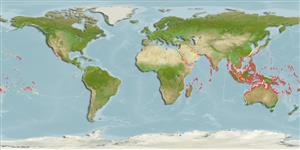
مرتبطة بالشعاب; نطاق العمق 4 - 30 m (مرجع 122). Tropical; 31°N - 33°S, 29°E - 134°W
Indo-West Pacific: East Africa to French Polynesia.
الطول عند النضج الأول / الحجم / وزن / العمر
النضج: Lm ? range ? - ? cm Max length : 100.0 cm TL ذكر/ مختلط الجنس; (مرجع 800); common length : 55.0 cm TL ذكر/ مختلط الجنس; (مرجع 122); أعلا وزن تم نشرة: 6.0 kg (مرجع 122)
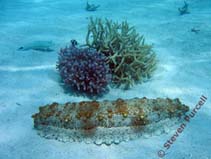
Mean live weight: 3500-6000 g. Body-wall thickness: 1.5 cm. Body firm, rigid, square-ish in cross-section, flattened ventrally (trivium). Bivium entirely covered with numerous characteristic, conical papillae and minute podia; bivium demarcated from the trivium by a row of large papillae. Podia numerous on trivium, with large disc, about 600 micrometer in diameter. Mouth ventral, surrounded by circle of 18 large brown tentacles. Anus terminal. Calcareous ring with large radial pieces and narrow interradials. Cuvierian tubules absent. Cloaca large. Bivium cream colored, with large beige dots; trivium generally beige; mature gonads deep purple. Spicules on tegument with branched spicules showing polygonal holes, and spicules in form of a "rose window", mostly abundant in the tentacles; tentacles also with straight, curved, or X-shaped rods; ventral podia with short, smooth rods; dorsal papillae with sparse, very long, spiny rods.
Rarely harvested until a few years ago. Collected by skin diving or using diving gear (if not banned), making the populations presently very vulnerable, due to overexploitation. The processed product is probably of low to moderate commercial value and the exploitation of this species should be avoided. Minimum depth range from Ref. 125194. A rare species mostly found at depths between 10 to 30 m; generally occurs on hard ground, large rubbles and sand patches, on reef slopes, outer lagoon and near passes. Populations not reaching high densities, with a mean of around 0.001 per square meter. Biology poorly known (Ref. 122).
دورة الحياة وسلوك التزاوج
النضج | التكاثر | وضع البيض | بيض | الخصوبة | اليرقات
Members of the class Holothuroidea are gonochoric and have only one gonad. Spawning and fertilization are both external and some exhibit brooding. Life cycle: Embryos develop into planktotrophic larvae (auricularia) then into doliolaria (barrel-shaped stage) which later metamorphose into juvenile sea cucumbers.
Conand, C. 1998 Holothurians (sea cucumbers, Class Holothuroidea). p. 1157-1190. In Carpenter, K.E. and V.H. Niem (eds.) FAO Species Identification Guide for Fishery Purposes. The Living Marine Resources of the Western Central Pacific. Vol. 2. Cephalopods, crustaceans, holothurians and sharks. FAO Rome. (مرجع 122)
حالة القائمة الحمراء للاتحاد الدولي لحفظ الطبيعة والموارد الطبيعية
(مرجع 130435: Version 2025-2 (Global))
حالته حسب اتفاقية سايتس (مرجع 108899)
Not Evaluated
خطر للأنسان
Harmless
استخدامات بشرية
مصائد: غير مهمة تجارياً
FAO - Publication: search | FishSource |
أدوات
مزيد من المعلومات
علم البيئة الغذائيةالمواد الغذائية (الفرائس)
التركيبة الغذائية
استهلاك الأغذية
مفتريسات
دورة الحياةالتكاثرالنضجالخصوبةوضع البيضبيضتطور البيضةاليرقات علم وظائف الأعضاءاستهلاك الأوكسجين
ذات الصلة بالبشرطوابع بريدية وعملات معدنية ومتنوعة
مصادر علي الأنترنت
تقديرات تستند إلى النماذج
ضعف الصيد
(مرجع 71543) |
High vulnerability (60 of 100). |
فئة السعر
(مرجع 80766): |
Unknown. |