Malacostraca |
Decapoda |
Calappidae
Lingkungan: lingkungan / zona iklim / kisaran kedalaman / jangkauan distribusi
Ekologi
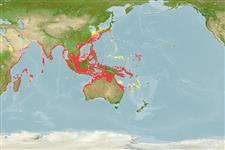
Berasosiasi dengan karang; kisaran kedalaman 10 - 100 m (Acuan 343). Tropical; 38°N - 28°S, 33°E - 171°E
Indo-Pacific: Japan to Southeast Asia, Australia to Sri Lanka.
Panjang pada saat jatuh tempo pertama / Ukuran / Berat / umur
Kematangan: Lm ? range ? - ? cm Max length : 10.0 cm CW jantan/; (Acuan )
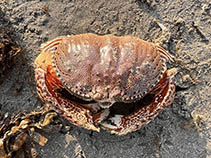
Clypeiform posterolateral part of carapace with strong lateral projections. Ground color yellowish beige to yellow; posterior 1/3 of carapace with distinct red spots, posterolateral part with transverse red stripes; outer surface of cheliped with red streaks and spots.
Sandy-muddy area. Burrows body on soft and mud substrates (Ref. 343). In general, Calappa sp. feeds upon mollusks and hermit crabs in gastropod shells. Their right claw is used for crushing shells of prey while their left claw is used as a cutter (Ref. 105092).
Siklus hidup dan perilaku kawin
Kematangan | Reproduksi, perkembang biakan | Pemijahan | telur-telur | Fekunditas | Larva
Members of the order Decapoda are mostly gonochoric. Mating behavior: Precopulatory courtship ritual is common (through olfactory and tactile cues); usually indirect sperm transfer.
rujukan utama
Acuan | Koordinator | mitra
Ng, P.K.L. 1998 Crabs. p. 1045-1155. In K.E. Carpenter and V.H. Niem (eds) FAO species identification guide for fishery purposes. The living marine resources of the Western Central Pacific. Volume 2. Cephalopods, crustaceans, holothurians and sharks. Rome, FAO. 1998. pp. 687-1396. (Acuan 343)
Status IUCN Red List
(Acuan 130435: Version 2025-2 (Global))
status CITES (Acuan 108899)
Not Evaluated
Not Evaluated
ancaman kepada manusia
Harmless
penggunaan manusia
FAO - Publication: search | FishSource |
Alat, peralatan
informasi lanjut
Ekologi trofikItem makanan (mangsa)
Komposisi makanan
Konsumsi makanan
Pemangsa
Dinamika populasiPertumbuhanMaks. usia / ukuranPanjang-berat rel.Panjang-panjang rel.ukuran frekuensiKonversi massaKelimpahan FisiologiKonsumsi oksigen
Yang berhubungan dengan manusiaPerangko, koin, dll.
Sumber internet
Estimasi berdasarkan model
Kerentanan Penangkapan Ikan
(Acuan 71543) |
Low vulnerability (10 of 100). |
kategori harga
(Acuan 80766): |
Unknown. |