Malacostraca |
Decapoda |
Calappidae
Environnement : milieu / zone climatique / profondeur / gamme de distribution
Écologie
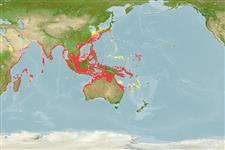
Récifal; profondeur 10 - 100 m (Réf. 343). Tropical; 38°N - 28°S, 33°E - 171°E
Indo-Pacific: Japan to Southeast Asia, Australia to Sri Lanka.
Longueur à la première maturité / Taille / Poids / Âge
Maturité: Lm ? range ? - ? cm Max length : 10.0 cm CW mâle / non sexé; (Réf. )
Description synthétique
Morphologie
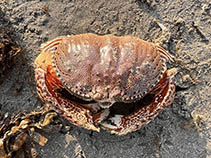
Clypeiform posterolateral part of carapace with strong lateral projections. Ground color yellowish beige to yellow; posterior 1/3 of carapace with distinct red spots, posterolateral part with transverse red stripes; outer surface of cheliped with red streaks and spots.
Sandy-muddy area. Burrows body on soft and mud substrates (Ref. 343). In general, Calappa sp. feeds upon mollusks and hermit crabs in gastropod shells. Their right claw is used for crushing shells of prey while their left claw is used as a cutter (Ref. 105092).
Cycle de vie et comportement reproducteur
Maturité | Reproduction | Frai | Œufs | Fécondité | Larves
Members of the order Decapoda are mostly gonochoric. Mating behavior: Precopulatory courtship ritual is common (through olfactory and tactile cues); usually indirect sperm transfer.
Ng, P.K.L. 1998 Crabs. p. 1045-1155. In K.E. Carpenter and V.H. Niem (eds) FAO species identification guide for fishery purposes. The living marine resources of the Western Central Pacific. Volume 2. Cephalopods, crustaceans, holothurians and sharks. Rome, FAO. 1998. pp. 687-1396. (Réf. 343)
Statut dans la liste rouge de l'IUCN
(Réf. 130435: Version 2025-2 (Global))
statut CITES (Réf. 108899)
Not Evaluated
Not Evaluated
Menace pour l'homme
Harmless
Utilisations par l'homme
FAO - Publication: search | FishSource |
Outils
Plus d'informations
Écologie trophiqueAliments (proies)
Composition du régime alimentaire
Consommation alimentaire
Prédateurs
Dynamique des populationsCroissanceÂges / tailles maximalesLongueur-poids rel.Rel. longueur-longueur.Fréquences de longueursConversion de masseAbondance Cycle de vieReproductionMaturitéFéconditéFraiŒufsDéveloppement de l'œufLarves PhysiologieConsommation d'oxygène
Liées à l'hommeTimbres, pièces de monnaie, divers
Sources Internet
Estimations basées sur des modèles
Vulnérabilité de la pêche
(Réf. 71543) |
Low vulnerability (10 of 100). |
Catégorie de prix
(Réf. 80766): |
Unknown. |