Bivalvia |
Arcida |
Arcidae
สิ่งแวดล้อม : สิ่งแวดล้อม / เขตภูมิอากาศ / ระดับความลึก / ระยะการกระจายสินค้า
นิเวศวิทยา
Benthic; ระดับความลึก 0 - 25 m (อ้างอิง 348). Tropical; 36°N - 32°S, 29°E - 137°W
Indo-Pacific: Eastern Africa to Japan, Australia, eastern Polynesia and Hawaii.
ความยาวเมื่อครบกำหนดครั้งแรก / ขนาด / น้ำหนัก / อายุ
วัยเจริญพันธุ์: Lm ? range ? - ? cm Max length : 10.5 cm TL เพศผู้/กระเทย; (อ้างอิง 348); common length : 7.0 cm TL เพศผู้/กระเทย; (อ้างอิง 348)
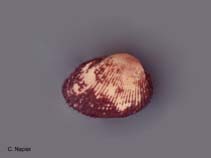
Shell inequivalve, solid, inequilateral, obliquely ovate and elongate in outline, with an extended posteroventral part. Umbones much inflated, situated rather forwards, cardinal area narrow and elongate. About 40 radial ribs (35 to 44) at each valve; ribs usually with a narrow median groove on top, most visible towards the anterior ventral margin of valves in mature specimens. Periostracum coarse and velvety, often eroded on umbones. Internal margins with strong crenulations corresponding with the external radial ribs. No byssal gape. Colour: outside of shell greyish white, often stained darker grey on umbonal and posterior areas; periostracum dark brown. Inner side white, sometimes light yellow in the umbonal cavity.
Common on sand (Ref. 75831) and muddy bottoms at intertidal and sublittoral depths to 25 m (Refs. 348, 75831, 128042).
วงจรชีวิตและพฤติกรรมการผสมพันธุ์
วัยเจริญพันธุ์ | การสืบพันธุ์ | การวางไข่ | เซลสืบพันธ์ของเพศเมีย(ไข่) | ความดกของไข่ | ตัวอ่อน
Members of the class Bivalvia are mostly gonochoric, some are protandric hermaphrodites. Life cycle: Embryos develop into free-swimming trocophore larvae, succeeded by the bivalve veliger, resembling a miniature clam.
Poutiers, J.M. 1998 Bivalves. Acephala, Lamellibranchia, Pelecypoda. p. 123-362. In Carpenter, K. E. and V. H. Niem. 1998. FAO species identification guide for fishery purposes. The living marine resources of the Western Central Pacific. Volume 1. Seaweeds, corals, bivalves, and gastropods. Rome, FAO. (อ้างอิง 348)
สถานะบัญชีแดงของ IUCN
(อ้างอิง 130435: Version 2025-2 (Global))
สถานะไซเตส (อ้างอิง 108899)
Not Evaluated
CMS (อ้างอิง 116361)
Not Evaluated
ภัยคุกคามต่อมนุษย์
Harmless
การใช้ของมนุษย์
การประมง: การค้า
FAO - Publication: search | FishSource |
เครื่องมือ
ข้อมูลเพิ่มเติม
นิเวศวิทยาเขตร้อนรายการอาหาร (เหยื่อ)
องค์ประอบของอาหาร
การบริโภคอาหาร
ผู้ล่า
เกี่ยวข้องกับมนุษย์แสตมป์ เหรียญ อื่นๆ
แหล่งที่มาจากอินเตอร์เน็ต
การประมาณค่าตามแบบจำลอง
ความสามารถในการกลับคืนสู่ปกติ
(Ref. 69278): |
ความสูง, เวลาต่ำสุดที่จะทำให้ประชากรเพิ่มขึ้นเป็น 2 เท่าใช้เวลาน้อยกว่า 15 เดือน (K=0.78) |
ความเสี่ยงต่อการตกปลา
(อ้างอิง 71543) |
Low vulnerability (10 of 100). |
หมวดหมู่ราคา
(อ้างอิง 80766): |
Medium. |