Bivalvia |
Arcida |
Arcidae
Miljö: miljö / Klimatzon / djupintervall / distributionsområde
Ekologi
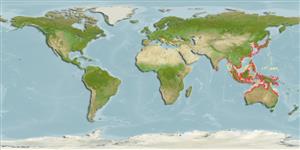
Benthic; brackvatten; djupintervall 0 - 30 m (Ref. 108826), usually 15 - 25 m (Ref. 108821). Tropical; 47°N - 26°S, 32°E - 154°E
Indo-West Pacific. Introduced in the Mediterranean and Black Sea. Tropical to subtropical.
Längd vid första mognad / Storlek / Vikt / Ålder
Könsmognad: Lm ? range ? - ? cm Max length : 9.5 cm TL hane/ej könsbestämd; (Ref. 348); common length : 8.0 cm TL hane/ej könsbestämd; (Ref. 348)
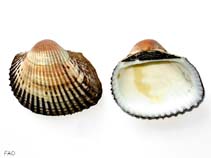
Shell thick and solid, inflated, inequilateral, roughly quadrate in shape with arcuate ventral margin and obliquely truncate posterior margin; slightly inequivalve, left valve distinctly overlapping the right valve ventrally and posteriorly. Cardinal area rather long and narrow. About 33 radial ribs (30 to 36) at each valve; ribs as wide as the interstices, granulated on left valve. Periostracum well developed. Internal margins with strong crenulations corresponding with the external radial ribs. No byssal gape. Colour: outside of shell white under the blackish brown periostracum. Inner side whitish.
Common depth values based on occurrence. On fine muddy-sand bottoms (Ref. 126564), in bays and coastal lagoons (Ref. 348 and 75831).
Livscykel och parningsbeteende
Könsmognad | Reproduktion | Lek | Ägg | Fekunditet | Larver
Members of the class Bivalvia are mostly gonochoric, some are protandric hermaphrodites. Life cycle: Embryos develop into free-swimming trocophore larvae, succeeded by the bivalve veliger, resembling a miniature clam.
Poutiers, J.M. 1998 Bivalves. Acephala, Lamellibranchia, Pelecypoda. p. 123-362. In Carpenter, K. E. and V. H. Niem. 1998. FAO species identification guide for fishery purposes. The living marine resources of the Western Central Pacific. Volume 1. Seaweeds, corals, bivalves, and gastropods. Rome, FAO. (Ref. 348)
Status på IUCN:s rödlista
(Ref. 130435: Version 2025-2 (Global))
CITES-status (Ref. 108899)
Not Evaluated
Not Evaluated
Hot mot människor
Mänskliga användningsområden
Fiskeri: kommersiell
FAO - Publication: search | FishSource | Havet omkring oss
Verktyg
Ytterligare information
Trofisk ekologiLivsmedelsartiklar (preys)
Födosammansättning
Födointag
Predatorer
PopulationsdynamikTillväxtMax. åldrar / storlekarLängd-vikt rel.Längd-längd rel.Längd-frekvenserMassakonverteringAbundans LivscykelReproduktionKönsmognadFekunditetLekÄggUtveckling av äggLarver MänniskorelateradFrimärken, mynt, diverse.
Internet-källor
Uppskattningar baserade på modeller
Resiliens
(Ref. 69278): |
Mellan, lägsta populationsfördubblingstid 1,4-4,4 år (K=0.2) |
Sårbarhet i fisket
(Ref. 71543) |
Low to moderate vulnerability (35 of 100). |
Priskategori
(Ref. 80766): |
Unknown. |