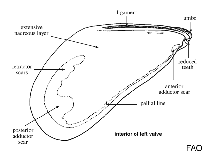
Bivalvia |
Mytilida |
Mytilidae
Umwelt: Milieu / Klimazone / Tiefenbereich / Verbreitungsgebiet
Ökologie
Benthic; tiefenbereich 0 - 40 m (Ref. 125441). Temperate; 7°C - 16°C (Ref. 78191), preferred 12°C (Ref. 107945); 11°S - 58°S, 78°W - 160°E
South Pacific, Southern Atlantic, and Antarctic Indian Ocean: From southern Brazil to Tierra del Fuego in the Atlantic and from Beagle Channel to El Callo, Peru. Also from South Africa to Namibia, Kerguelen and Macquarie Island. Introduced in UK. Tropical to polar.
Länge bei der ersten Reifung / Größe / Gewicht / Alter
Geschlechtsreife: Lm ?, range 2 - ? cm Max length : 9.5 cm SHL Männchen/unbestimmt; (Ref. 109255)
Length information from sampling in the Patagonian shelf. Collected individuals were 47-63 mm in length (Ref. 78355). Found in shallow subtidal benthic communities of two islands in Saldanha Bay (Ref. 78353) and dominated the sessile fauna of Robben Island at depths beyond 17 m (Ref. 78192). Found attached to rocky substrates, associated with holdfasts of juvenile brown algae, and may occasionally reach greater depths; may be found isolated in intertidal or forming large banks in eulittoral (Ref. 87801). It is also found in forests of Macrocystis pyrifera (Ref. 92889).
Lebenszyklus und Paarungsverhalten
Geschlechtsreife | Fortpflanzung | Ablaichen | Eier | Fruchtbarkeit | Larven
Members of the class Bivalvia are mostly gonochoric, some are protandric hermaphrodites. Life cycle: Embryos develop into free-swimming trocophore larvae, succeeded by the bivalve veliger, resembling a miniature clam.
SAUP Database 2006 SAUP Database. www.seaaroundus.org. (Ref. 356)
IUCN Rote Liste Status
(Ref. 130435: Version 2025-2 (Global))
CITES Status (Ref. 108899)
Not Evaluated
Not Evaluated
Bedrohung für Menschen
Nutzung durch Menschen
Fischereien: kommerziell
FAO - Aquaculture Systems: production searchFischereien: Artbeschreibung, landings search; Publication: search | FishSource | Das Meer um uns herum
Tools
Mehr Information
Trophische ÖkologieLebensmittel (Beutetiere)NahrungszusammensetzungNahrungsaufnahmeRäuber PhysiologieSauerstoffverbrauch
MenschenbezogenBriefmarken, Münzen, Verschiedenes.
Internet Quellen
Schätzungen auf der Grundlage von Modellen
Widerstandsfähigkeit
(Ref. 69278): |
mittel, Verdopplung der Population dauert 1,4 - 4,4 Jahre. (K=0.16-0.42) |
Anfälligkeit der Fischerei
(Ref. 71543) |
Low to moderate vulnerability (32 of 100). |
Klimaanfälligkeit
(Ref. 125649) |
High vulnerability (57 of 100) |
Preiskategorie
(Ref. 80766): |
Low. |
Nutrients
|
Calcium = 149 [71, 228] mg/100g; Iron = 8.53 [1.95, 15.11] mg/100g; Protein = 9.88 [8.64, 11.12] %; Omega3 = 0.313 [0.202, 0.423] g/100g; Selenium = 61 [50, 72] μg/100g; VitaminA = 0 μg/100g; Zinc = 2.04 [0.56, 3.51] mg/100g (wet weight); based on nutrient studies. |