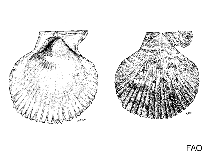
Bivalvia |
Pectinida |
Pectinidae
Environnement : milieu / zone climatique / profondeur / gamme de distribution
Écologie
Benthic; profondeur 0 - 100 m (Réf. 356), usually 2 - 80 m (Réf. 75831). Temperate, preferred 17°C (Réf. 107945); 56°N - 35°N, 127°E - 151°E
Northwest Pacific: from the Sea of Japan (North and South Korea and Russia) to Pacific coast of Japan (35°N) to the Sea of Okhotsk, southern Sakhalin and southern Kuril Islands. Introduced in Northeast Atlantic and the Mediterranean.
Longueur à la première maturité / Taille / Poids / Âge
Maturité: Lm ? range ? - ? cm Max length : 25.0 cm SHL mâle / non sexé; (Réf. )
Occurs on sandy, silty and muddy bottoms. Suspension feeder (Ref. 106923).
Cycle de vie et comportement reproducteur
Maturité | Reproduction | Frai | Œufs | Fécondité | Larves
Life cycle: Embryos develop into free-swimming trocophore larvae, succeeded by the bivalve veliger, resembling a miniature clam (Ref. 833).
SAUP Database 2006 SAUP Database. www.seaaroundus.org. (Réf. 356)
Statut dans la liste rouge de l'IUCN
(Réf. 130435: Version 2025-2 (Global))
statut CITES (Réf. 108899)
Not Evaluated
Not Evaluated
Menace pour l'homme
Utilisations par l'homme
Pêcheries: commercial; Aquaculture: commercial
FAO - Aquaculture Systems: Résumé espèce, production search; pêcheries: landings search; Publication: search | FishSource | Sea Around Us
Outils
Plus d'informations
Dynamique des populations PhysiologieConsommation d'oxygène
Liées à l'hommeTimbres, pièces de monnaie, divers
Sources Internet
Estimations basées sur des modèles
Résilience
(Ref. 69278): |
Haut, temps minimum de doublement de population inférieur à 15 mois (K=0.87-0.98) |
Vulnérabilité de la pêche
(Réf. 71543) |
Low vulnerability (13 of 100). |
Vulnérabilité climatique
(Réf. 125649) |
High vulnerability (58 of 100) |
Catégorie de prix
(Réf. 80766): |
Unknown. |