Gastropoda |
Ostreida |
Margaritidae
Environnement : milieu / zone climatique / profondeur / gamme de distribution
Écologie
Benthic; profondeur 0 - 60 m (Réf. 348), usually 5 - 30 m (Réf. 348). Tropical
Indo-West Pacific: from Nicobar and Andaman Islands to Melanesia; north to Japan and south to Queensland and Western Australia; Borneo and Moluccas.
Longueur à la première maturité / Taille / Poids / Âge
Maturité: Lm ? range ? - ? cm Max length : 30.0 cm ShL mâle / non sexé; (Réf. 348); common length : 20.0 cm SHH mâle / non sexé; (Réf. 348)
Description synthétique
Morphologie
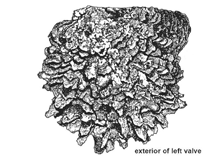
Shell rather thick and large (attaining 30 cm in length), subcircular in outline, with a short and ill-defined posterior ear which is not drawn out into a wing-like process. Anterior margin markedly protruding beyond the tip of anterior ear. Outer surface of valves, when not worn, covered with flattened, imbricating concentric scales bearing large and irregular, flat spines with blunt ends, roughly arranged in radial rows and projecting at shell margins. Hinge completely devoid of teeth. Colour: outside of shell uniformly fawn, sometimes with radial stripes of darker spots in umbonal region; then, ground colour in that region green, dark brown, or purple. Internal nacreous area highly lustrous, silvery with a variably extended golden border. Non-nacreous margin clear, of plain horny colour.
Mainly in clear water under the influence of currents. Often in dense colonies. Littoral and sublittoral to a depth of 60 m; most common from sublittoral at depths of 5 to 30 m (Ref. 348). On various bottoms, byssally attached to hard substrates at least in the young stages (Ref. 348). Inhabits a broad range of habitat, from sand, mud, gravel, seagrass beds, deep-water reefs, to near sponges, soft corals or whip corals. Filter-feeder (Ref. 101206).
Cycle de vie et comportement reproducteur
Maturité | Reproduction | Frai | Œufs | Fécondité | Larves
Members of the class Bivalvia are mostly gonochoric, some are protandric hermaphrodites. Life cycle: Embryos develop into free-swimming trocophore larvae, succeeded by the bivalve veliger, resembling a miniature clam.
SAUP Database 2006 SAUP Database. www.seaaroundus.org. (Réf. 356)
Statut dans la liste rouge de l'IUCN
(Réf. 130435: Version 2025-2 (Global))
statut CITES (Réf. 108899)
Not Evaluated
Not Evaluated
Menace pour l'homme
Utilisations par l'homme
Pêcheries: commercial
FAO - Publication: search | FishSource | Sea Around Us
Outils
Plus d'informations
Dynamique des populations Cycle de vieReproductionMaturitéFéconditéFraiŒufsDéveloppement de l'œufLarves PhysiologieConsommation d'oxygène
Liées à l'hommeTimbres, pièces de monnaie, divers
Sources Internet
Estimations basées sur des modèles
Résilience
(Ref. 69278): |
Haut, temps minimum de doublement de population inférieur à 15 mois (K=0.72-0.79) |
Vulnérabilité de la pêche
(Réf. 71543) |
Low vulnerability (18 of 100). |
Catégorie de prix
(Réf. 80766): |
Unknown. |
Nutrients
|
Calcium = 149 [71, 228] mg/100g; Iron = 8.53 [1.95, 15.11] mg/100g; Protein = 9.88 [8.64, 11.12] %; Omega3 = 0.313 [0.202, 0.423] g/100g; Selenium = 61 [50, 72] μg/100g; VitaminA = 0 μg/100g; Zinc = 2.04 [0.56, 3.51] mg/100g (wet weight); based on nutrient studies. |