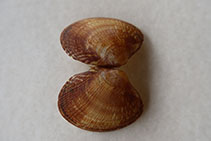
Bivalvia |
Venerida |
Veneridae
पर्यावरण: पर्यावरण / जलवायु क्षेत्र / गहराई सीमा / वितरण सीमा
पारिस्थितिकी
Benthic; खारा; pH range: 13.5 - 35.0; गहराई सीमा 0 - 100 m (संदर्भ 356). Tropical; ? - 35°C (संदर्भ 104360), preferred 18°C (संदर्भ 107945); 56°N - 11°S, 75°E - 164°E (संदर्भ 348)
Indo-Pacific and the Mediterranean: from India and Sri Lanka to Micronesia; north to Sakhalin, the Japan Sea and Hawaii (introduced), and south to Indonesia. Introduced in the Northeast Atlantic.
प्रथम परिपक्वता पर लंबाई / आकार / वज़न / आयु
परिपक्व अवधि: Lm 2.7 range ? - ? cm Max length : 8.0 cm SHL पुल्लिंग / अलिंग; (संदर्भ 348); common length : 5.0 cm SHL पुल्लिंग / अलिंग; (संदर्भ 348); अधिकतम सूचित उम्र: 14 वर्षो (संदर्भ 104360)
Introduced incidentally with Japanese oysters (Crassostrea gigas), or for aquaculture trials, in many areas (Ref. 348). Found in littoral to sublittoral sediments (Ref. 1314). Intertidal and upper subtidal flats (Ref. 106937). Common in protected marine areas (Ref. 348). With short siphons and buries to only about 10 cm deep in a variety of substrates, from mud, sand, and gravel, high along intertidal areas (Refs. 95344, 104238). Occasionally overlaps with Zostera japonica beds or Zostera marina beds in the intertidal (Ref. 106937). Suspension feeder. Diet includes phytoplankton (Refs. 104238, 104360), benthic diatoms, and terrestrial organic matter (Ref. 104238).
Broadcast spawners. Life cycle: Embryos develop into free-swimming trocophore larvae, succeeded by the bivalve veliger (with ciliated vellum to assist mobility and feeding), resembling a miniature clam. After 2-4 weeks, it develops into a peliveliger with a formed foot to assist further with swimming, as well as byssal threads to help the clam secure itself onto the seafloor once it finds a suitable substrate to settle on. Burrowing into the ground allows the animal to find food and be protected from predators. Once settled, it will stay in the substrate and continue to grow into a mature clam.
SAUP Database 2006 SAUP Database. www.seaaroundus.org. (संदर्भ 356)
आईयूसीएन रेड लिस्ट स्थिति
(संदर्भ 130435: Version 2025-2 (Global))
CITES स्थिति (संदर्भ 108899)
Not Evaluated
CMS (संदर्भ 116361)
Not Evaluated
मनुष्यों के लिए ख़तरा
मानव उपयोग
मात्स्यिकी: व्यापारिक
FAO - Aquaculture Systems: प्रजातियों की प्रोफ़ाइल, production search; मात्स्यिकी: प्रजातियों की प्रोफ़ाइल, landings search; Publication: search | FishSource | हमारे चारों ओर समुद्र
साधन
अधिक जानकारी
फिजियोलॉजीप्राणवायु की खपत
मानव संबंधीटिकट, सिक्के, विविध.
इंटरनेट स्रोत
मॉडल पर आधारित अनुमान
लौटाव
(Ref. 69278): |
ऊंचा, न्यूनतम जनसंख्या दुगनी समय अवलागत 15 महीने। (K=0.3-0.91; tm=1.5; tmax=14) |
Rate of population increase
|
Prior r = 1.19, 95% CL = 0.79 - 1.79, Based on 1 data-limited stock assessment. |
मछली पकड़ने की भेद्यता
(संदर्भ 71543) |
Low to moderate vulnerability (31 of 100). |
जलवायु भेद्यता
(संदर्भ 125649) |
High to very high vulnerability (71 of 100) |
मूल्य श्रेणी
(संदर्भ 80766): |
Medium. |
Nutrients
|
Calcium = 149 [71, 228] mg/100g; Iron = 8.53 [1.95, 15.11] mg/100g; Protein = 9.88 [8.64, 11.12] %; Omega3 = 0.313 [0.202, 0.423] g/100g; Selenium = 61 [50, 72] μg/100g; VitaminA = 0 μg/100g; Zinc = 2.04 [0.56, 3.51] mg/100g (wet weight); based on nutrient studies. |