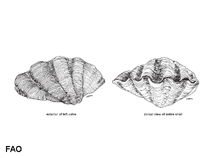
Bivalvia |
Cardiida |
Cardiidae
Environnement : milieu / zone climatique / profondeur / gamme de distribution
Écologie
Benthic; profondeur 0 - 20 m (Réf. 348), usually 0 - 15 m (Réf. 75831). Tropical; 23°C - 30°C (Réf. 102835); 19°N - 34°S, 100°E - 174°W (Réf. 106696)
Indo-West Pacific.
Longueur à la première maturité / Taille / Poids / Âge
Maturité: Lm ? range ? - ? cm Max length : 60.0 cm SHL mâle / non sexé; (Réf. 348); common length : 50.0 cm SHL mâle / non sexé; (Réf. 348)
Description synthétique
Morphologie
It is characterized by a low primary and radial sculpture, variable shape, massive umbonal area and smooth white shell.
Locally exploited for meat and shell. This species was previously quite abundant, but has been over collected in many areas. Aquaculture attempts being made (Ref. 348). Found in intertidal areas on corals (Ref. 75831), mainly on reef flats, barrier reefs, fore reefs and atoll lagoons (Ref. 117184). Common in shallow waters wherein juveniles are byssally attached to the tops and sides of coral outcrops. Adults are thought to detach their byssus and settle in clear ocean conditions at 20 m depth (Ref. 101207).
Cycle de vie et comportement reproducteur
Maturité | Reproduction | Frai | Œufs | Fécondité | Larves
Life cycle: Embryos develop into free-swimming trocophore larvae, succeeded by the bivalve veliger, resembling a miniature clam (Ref. 833).
SAUP Database 2006 SAUP Database. www.seaaroundus.org. (Réf. 356)
Statut dans la liste rouge de l'IUCN
(Réf. 130435: Version 2025-2 (Global))
statut CITES (Réf. 108899)
Not Evaluated
Menace pour l'homme
Utilisations par l'homme
Pêcheries: commercial
FAO - Aquaculture Systems: production search; Publication: search | FishSource | Sea Around Us
Outils
Plus d'informations
Écologie trophiqueAliments (proies)
Composition du régime alimentaire
Consommation alimentaire
Prédateurs
Dynamique des populations PhysiologieConsommation d'oxygène
Liées à l'hommeTimbres, pièces de monnaie, divers
Sources Internet
Estimations basées sur des modèles
Résilience
(Ref. 69278): |
Faible, temps minimum de doublement de population : 4,5 à 14 années (K=0.11-0.11; tm=4) |
Vulnérabilité de la pêche
(Réf. 71543) |
High vulnerability (57 of 100). |
Catégorie de prix
(Réf. 80766): |
Unknown. |