Bivalvia |
Cardiida |
Cardiidae
Miljö: miljö / Klimatzon / djupintervall / distributionsområde
Ekologi
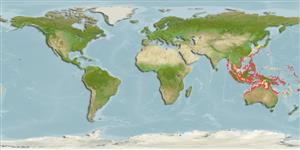
Benthic; djupintervall 0 - 35 m (Ref. 75831). Tropical; 23°C - 30°C (Ref. 102835); 38°N - 29°S, 92°E - 178°W
Indo-Pacific: from Myanmar then east to Wallis and Futuna, north to Japan and south to western Australia. Introduced beyond Wallis and Futuna in the Pacific.
Längd vid första mognad / Storlek / Vikt / Ålder
Könsmognad: Lm ?, range 25 - 35 cm Max length : 137 cm SHL hane/ej könsbestämd; (Ref. 99323); common length : 80.0 cm SHL hane/ej könsbestämd; (Ref. 348); publicerad maxvikt: 500.0 kg (Ref. 81839)
It is white and fan-shaped with deep radiating ribs.
Known to be the largest bivalve mollusks that exist. Exploited for its meat and shell, this species has recently become nearly extinct within an important part of its range, due to over collecting. Trials of aquaculture under progress for the restocking of reefs and local farming (Ref. 348). Facultative planktotroph. It has an established symbiotic relationship with a dinoflagellate algae (zooxanthellae) which allows them to survive. It ingests the algae at an early stage and the latter propagates in the gut (Ref. 100719).
Livscykel och parningsbeteende
Könsmognad | Reproduktion | Lek | Ägg | Fekunditet | Larver
Becomes simultaneous hermaphrodite in its later years. Spawning is seasonal, based on its northern and southern limits of distribution (Ref. 100714).
SAUP Database 2006 SAUP Database. www.seaaroundus.org. (Ref. 356)
Status på IUCN:s rödlista
(Ref. 130435: Version 2025-2 (Global))
CITES-status (Ref. 108899)
Not Evaluated
Hot mot människor
Mänskliga användningsområden
Fiskeri: kommersiell; Vattenbruk: kommersiell
FAO - Aquaculture Systems: production search; Publication: search | FishSource | Havet omkring oss
Verktyg
Ytterligare information
MänniskorelateradFrimärken, mynt, diverse.
Internet-källor
Uppskattningar baserade på modeller
Resiliens
(Ref. 69278): |
Låg, lägsta populationsfördubblingstid 4,5-14 år (K=0.07-0.2) |
Sårbarhet i fisket
(Ref. 71543) |
High to very high vulnerability (73 of 100). |
Priskategori
(Ref. 80766): |
Unknown. |
Nutrients
|
Calcium = 149 [71, 228] mg/100g; Iron = 8.53 [1.95, 15.11] mg/100g; Protein = 9.88 [8.64, 11.12] %; Omega3 = 0.313 [0.202, 0.423] g/100g; Selenium = 61 [50, 72] μg/100g; VitaminA = 0 μg/100g; Zinc = 2.04 [0.56, 3.51] mg/100g (wet weight); based on nutrient studies. |