Bivalvia |
Cardiida |
Cardiidae
Umwelt: Milieu / Klimazone / Tiefenbereich / Verbreitungsgebiet
Ökologie
Riff-verbunden; standorttreu (Ref. 348); brackwasser; tiefenbereich 0 - 35 m (Ref. 348). Tropical; 23°C - 30°C (Ref. 102835); 28°N - 37°S, 31°E - 128°W
Indo-Pacific: Egypt to Pitcairn Islands and Ogasawara, Japan to Lord Howe Island.
Länge bei der ersten Reifung / Größe / Gewicht / Alter
Geschlechtsreife: Lm ?, range 6 - 13 cm Max length : 41.7 cm SHL Männchen/unbestimmt; (Ref. 117184); common length : 25.0 cm SHL Männchen/unbestimmt; (Ref. 348)
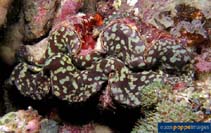
The mantle color is highly variable, ranging from bright blue to brown.
Collected for food and for the shell trade. Aquaculture trials have been done in 1998 (Ref. 348). Maximum depth from Ref. 75831. Found in coral reef flats in shallow areas (Ref. 799), reef areas of lagoons (Ref. 97298) and in intertidal areas (Ref. 75831). Mixotrophic - filter feeds and photosynthesizes via its zooxanthellae (Ref. 105208). Tridacnids derive their nutrition from uptake of dissolved matter through their epidermis and from their symbiotic zooanthella Symbiodinium microadriaticum (Ref. 107098).
Lebenszyklus und Paarungsverhalten
Geschlechtsreife | Fortpflanzung | Ablaichen | Eier | Fruchtbarkeit | Larven
Life cycle: Embryos develop into free-swimming trocophore larvae, succeeded by the bivalve veliger, resembling a miniature clam (Ref. 833).
SAUP Database 2006 SAUP Database. www.seaaroundus.org. (Ref. 356)
IUCN Rote Liste Status
(Ref. 130435: Version 2025-2 (Global))
CITES Status (Ref. 108899)
Not Evaluated
Bedrohung für Menschen
Reports of ciguatera poisoning (Ref. 130160)
Nutzung durch Menschen
Fischereien: kommerziell
FAO - Aquaculture Systems: production search; Publication: search | FishSource | Das Meer um uns herum
Tools
Mehr Information
PhysiologieSauerstoffverbrauch
MenschenbezogenBriefmarken, Münzen, Verschiedenes.
Internet Quellen
Schätzungen auf der Grundlage von Modellen
Widerstandsfähigkeit
(Ref. 69278): |
mittel, Verdopplung der Population dauert 1,4 - 4,4 Jahre. (K=0.18-0.28; tm=3.8) |
Rate of population increase
|
Prior r = 0.49, 95% CL = 0.32 - 0.73, Based on 1 data-limited stock assessment. |
Anfälligkeit der Fischerei
(Ref. 71543) |
Moderate to high vulnerability (45 of 100). |
Preiskategorie
(Ref. 80766): |
Unknown. |
Nutrients
|
Calcium = 149 [71, 228] mg/100g; Iron = 8.53 [1.95, 15.11] mg/100g; Protein = 9.88 [8.64, 11.12] %; Omega3 = 0.313 [0.202, 0.423] g/100g; Selenium = 61 [50, 72] μg/100g; VitaminA = 0 μg/100g; Zinc = 2.04 [0.56, 3.51] mg/100g (wet weight); based on nutrient studies. |