Bivalvia |
Cardiida |
Cardiidae
Miljö: miljö / Klimatzon / djupintervall / distributionsområde
Ekologi
Benthic; djupintervall 0 - 42 m (Ref. 117184). Tropical; 31°N - 32°S, 30°E - 124°W
Indo-Pacific: from East Africa to the Red Sea, (but not the Persian Gulf) to as far east as Pitcairn Islands, north to southern Japan, and south to Queensland, Australia and New Caledonia. Introduced in Hawaii and Guam.
Längd vid första mognad / Storlek / Vikt / Ålder
Könsmognad: Lm ?, range 16 - 20 cm Max length : 45.0 cm SHL hane/ej könsbestämd; (Ref. 95990); common length : 30.0 cm SHL hane/ej könsbestämd; (Ref. 348)
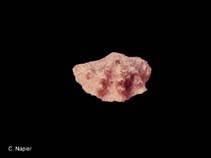
The species has an elongate shell with conspicuous fluted scales on its radial ridges. The valves are white and occasionally tinged with orange, and the mantle yellowish green.
Maximum depth from Ref. 87928. In eastern Polynesia, it is known to be restricted to deep water (Ref. 87928). Found in intertidal areas on corals (Ref. 75831). Abundant on outer reef slope (Ref. 2923). Also found in a lagoon (Ref. 87813), on sandy bottoms (Ref. 106695), rubble or in reef pockets (Ref. 2923). Unattached or weakly attached by byssus as an adult (Ref. 2923). Tridacnids derive their nutrition from uptake of dissolved matter through their epidermis and from their symbiotic zooanthella Symbiodinium microadriaticum (Ref. 107098).
Livscykel och parningsbeteende
Könsmognad | Reproduktion | Lek | Ägg | Fekunditet | Larver
Life cycle: Embryos develop into free-swimming trocophore larvae, succeeded by the bivalve veliger, resembling a miniature clam (Ref. 833).
SAUP Database 2006 SAUP Database. www.seaaroundus.org. (Ref. 356)
Status på IUCN:s rödlista
(Ref. 130435: Version 2025-2 (Global))
CITES-status (Ref. 108899)
Not Evaluated
Hot mot människor
Mänskliga användningsområden
Fiskeri: kommersiell
FAO - Aquaculture Systems: production search; Publication: search | FishSource | Havet omkring oss
Verktyg
Ytterligare information
MänniskorelateradFrimärken, mynt, diverse.
Internet-källor
Uppskattningar baserade på modeller
Resiliens
(Ref. 69278): |
Mellan, lägsta populationsfördubblingstid 1,4-4,4 år (K=0.08-0.23; tm=4) |
Sårbarhet i fisket
(Ref. 71543) |
Moderate to high vulnerability (50 of 100). |
Priskategori
(Ref. 80766): |
Unknown. |
Nutrients
|
Calcium = 149 [71, 228] mg/100g; Iron = 8.53 [1.95, 15.11] mg/100g; Protein = 9.88 [8.64, 11.12] %; Omega3 = 0.313 [0.202, 0.423] g/100g; Selenium = 61 [50, 72] μg/100g; VitaminA = 0 μg/100g; Zinc = 2.04 [0.56, 3.51] mg/100g (wet weight); based on nutrient studies. |