Aipysurus laevis, Olive-brown seasnake
Advertisement

You can sponsor this page

Aipysurus laevis   Lacépède, 1804

Olive-brown seasnake

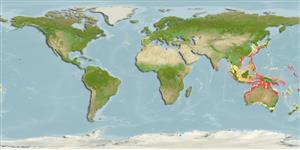
Native range | All suitable habitat | Point map | Year 2050
This map was computer-generated and has not yet been reviewed.
Aipysurus laevis  AquaMaps  Data sources: GBIF OBIS
上傳你的 相片 
所有照片 | Google 影像 |
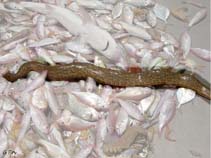
Image of Aipysurus laevis (Olive-brown seasnake)
Aipysurus laevis
Picture by Fry, Gary Charles

分類 / 名稱 俗名 | 同種異名 | CoL | ITIS | WoRMS

Reptilia | Squamata | Hydrophiidae

環境: 環境 / 氣候帶 / 深度上下限 / 配送範圍 生態學

礁區魚類; 深度上下限 3 - 50 m (參考文獻 2352).  Tropical; 51°N - 58°S (參考文獻 356)

分布 Territories | FAO區域 | 生態系 | 發現紀錄 | 簡介

Indo-Pacific, Northwest Atlantic and the Mediterranean. Tropical and subtropical climates.

初熟時的長度 / 大小 / 重量 / 年齡

成熟度: Lm 103.4, range 71 - 130 cm Max length : 200 cm TL 雄魚/尚未辨別雌雄; (參考文獻 2357); common length : 150 cm TL 雄魚/尚未辨別雌雄; (參考文獻 2357)

簡短描述 型態特徵

Cephalic plates are large, relatively regular (not very fragmented) and symmetrical, with constant partial fragmentation in parietal region. Parietal plates often split in two. Small notches are sometimes visible on the forehead. There often or always seems to be a small median scale between frontal and prefrontal plates in new Caledonian populations. Eyes are separated from supralabials by a row of subocular scales, which are actually larger than the supralabials. Some anterior supralabials that are quite expanded dorso-ventrally can come in direct contact with the eyes. First pair of infralabials touches the posterior part of the mental plate. Midbody body scales (21 to 25 in a row) are smooth and overlapping - these scales have smaller diffuse blunted tubercles. Ventral scales (135 to 155 scales) are much wider than adjacent scales. They are slightly imbricate posteriorly with a median keel that is not always visible. Anal keel is divided, with a relatively prominent keel on each half (Ref. 2357, 2355). Has highly variable coloration and patterns. Adults are commonly solid grey to olive grey with small orangey-brown area in the anterior head region. Juveniles are greyish brown with fine ring-shaped vertical white undulated barring. Anterior orangey brown area is visible at birth. Body coloration turns from brown to predominantly grey and the rings gradually fade with age. Several creamy white or darkly spotted scales are scattered over the body. Brown body scales are often dark in the middle, giving rise to faint longitudinal streaks. Tail is brown or relatively pale and uniform in color (Ref. 2352). Fangs may be 0.7 cm long (Ref. 88063).

生物學特性     字彙 (例如 附生動物)

Maximum and common lengths also from Ref. 2352. Found along seabeds but prefers coral reefs and can rarely be observed in outer reef slopes (Ref. 2353). It is a generalist feeder, swallowing prey found near the seabed (Ref. 2360) and feeds on several species of reef fish in size range, 3 to 15 cm, including small snappers (Lutjanus lutjanus and Lutjanus kasmira), catfish (Plotosus lineatus), red-barred shrimp (possibly Stenopus hispidus). Especially active at night and tends to attack anything bright and moving. It is a relatively curious and unaggressive snake but can be dangerous (Ref. 2352). Females are larger than males and are potentially more dangerous because of higher venom yield (Ref. 2359). Preyed upon by tiger sharks (Galeocerdo cuvier).

生命週期和交配行為 成熟度 | 繁殖 | 產卵場 | | 孕卵數 | 仔魚

Females are larger than males (Ref. 2359). Australia: It is a viviparous snake, which bears 1 to 5 large offspring, with an average of 3 offspring (Ref. 2357, 2355). Gestation period is around 9 months and only 50% of females seem to be gravid at the same time (biennial reproduction), suggesting that a full year is required for adipose tissue renewal (Ref. 2361). Reproduces throughout the year. One or even more males with frenzied appearance than usual start protruding and retracting their tongues very rapidly every time they meet. Become more frenzied when they encounter a receptive female, which also protrudes and retracts its tongue. Chosen male and receptive female coil and uncoil together. During mating, couple completely wraps and coils together while male hits the female's nape several times with its head (Ref. 2352).

主要參考資料 參考文獻 | 合作者 | 合作者

Ineich, I. and P. Laboute 2002 Sea snakes of New Caledonia. IRD Éditions. Institut de Recherche pour le Développement. Muséum national d'histoire naturelle. Collection Faune et flore tropicales. 39:302 pp. (參考文獻 2352)

IUCN 瀕危狀態 (參考文獻 130435: Version 2025-2 (Global))

  無危 (LC) ; Date assessed: 30 May 2018

CITES狀態 (參考文獻 108899)

Not Evaluated

CMS (參考文獻 116361)

Not Evaluated

對人類具威脅

人類使用


FAO - Publication: search | FishSource |

工具

更多資訊

營養生態學
生態學
人口動態
成長
最大年齡/尺寸
長度重量比
長度關係
長度-頻率
質量轉換
豐度
生命週期
繁殖
成熟度
孕卵數
產卵場

卵發育
仔魚
分布
生理學
耗氧量
人類相關
郵票、錢幣、雜項
外展服務
參考文獻

網路資源

BHL | BOLD Systems | CISTI | DiscoverLife | FAO - Publication: search | Fishipedia | GenBank (基因組, 核甘) | GloBI | Gomexsi | Google Books | Google Scholar | Google | PubMed | 樹狀分類階層 | Wikipedia (, 搜尋) | 動物學的記錄

基於模型的估計

回復力
(Ref. 69278):
高度, 族群倍增時間少於 15個月 (K=0.38)
釣魚的脆弱性
(參考文獻 71543)
High to very high vulnerability (69 of 100).
價格種類
(參考文獻 80766):
Unknown.