Bivalvia |
Ostreida |
Pinnidae
Entorno: milieu / zona climática / rango de profundidad / gama de distribución
Ecología
Benthic; rango de profundidad 0 - 200 m (Referencia 2754). Subtropical; 1°C - 39°C; 63°N - 41°S, 17°W - 137°W
Distribución
Territories | Áreas FAO | Ecosistemas | Ocurrencias, apariciones | Introducciones
Mediterranean and Indo-West Pacific: from southeast Africa to Melanesia and New Zealand; north to Japan and south to New South Wales. Tropical to subtropical.
Longitud en la primera madurez / Tamaño / Peso / Edad
Madurez: Lm 15.8, range 10 - ? cm Max length : 39.0 cm SHH macho / no sexado; (Referencia 124193); common length : 26.0 cm SHL macho / no sexado; (Referencia 348)
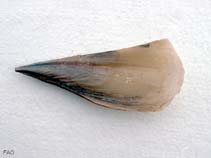
Shell reaching a large size, usually rather thin, fragile, moderately inflated and triangularly wedge-shaped in outline, with a highly variable sculpture. Dorsal margin nearly straight or slightly concave, posterior margin generally truncate. Ventral margin widely convex posteriorly, straightish to shallowly depressed anteriorly. Outer surface of valves with 15 to 30 radial ribs which may be smooth to densely set with short, open spines. Dorsal most radial rib frequently with a series of short and sharp spines protruding along the dorsal margin of shell. Inner surface of shell with shallow grooves corresponding to the external radial ribs. Internal nacreous layer rather thin, undivided, occupying the anterior 2/3 to 3/4 of valves. Posterior adductor scar completely enclosed within the nacreous area. Colour: outside of shell slightly shiny, translucent olivaceous tan, often tinged with darker purplish brown or grey toward the umbones. Interior similarly coloured, iridescent on nacreous area.
New Zealand populations are generally considered a distinct subspecies under the name Atrina pectinata zelandica (Gray, 1835). It is collected in many areas for food and fertilizer (Ref. 348). Minimum depth from Ref. 348. From low intertidal areas to depths of about 20 m (Ref. 348). From tidal flats to shallow subtidal environments (Ref. 106801). In sand or muddy sand with shells, with the ventral (open) portion of the shell facing towards the current (Ref. 348). Infaunal (Ref. 106801). Occurs in 15 to approximately 50 cm deep silts (Ref .106800). Tolerant to wide ranges of temperature and to low-salinity water (Ref. 348). In general, suspension feeding bivalves mainly depend on phytoplankton and detritus material for nutrition (Ref. 107088).
Ciclo vital y comportamiento de apareamiento
Madurez | Reproducción | Puesta | Huevos | Fecundidad | Larva
Members of the class Bivalvia are mostly gonochoric, some are protandric hermaphrodites. Life cycle: Embryos develop into free-swimming trocophore larvae, succeeded by the bivalve veliger, resembling a miniature clam.
Poutiers, J.M. 1998 Bivalves. Acephala, Lamellibranchia, Pelecypoda. p. 123-362. In Carpenter, K. E. and V. H. Niem. 1998. FAO species identification guide for fishery purposes. The living marine resources of the Western Central Pacific. Volume 1. Seaweeds, corals, bivalves, and gastropods. Rome, FAO. (Referencia 348)
Situación en la Lista Roja de la UICN
(Referencia 130435: Version 2025-2 (Global))
Estatus CITES (Referencia 108899)
Not Evaluated
CMS (Referencia 116361)
Not Evaluated
Amenaza para el ser humano
Usos humanos
Pesquerías: comercial
FAO - Publication: search | FishSource |
Herramientas
Más información
FisiologíaConsumo del oxígeno
Relacionados con el ser humanoSellos, monedas, varios
Fuentes de Internet
Estimaciones basadas en modelos
Resiliencia
(Ref. 69278): |
Alto, población duplicada en un tiempo mínimo inferior a 15 meses (K=0.53-0.78; tm=1) |
Vulnerabilidad pesquera
(Referencia 71543) |
Low vulnerability (23 of 100). |
Categoría de precios
(Referencia 80766): |
Unknown. |