Bivalvia |
Pectinida |
Pectinidae
Environnement : milieu / zone climatique / profondeur / gamme de distribution
Écologie
Benthic; profondeur 0 - 25 m (Réf. 348). Tropical
Indo-West Pacific: from East Africa, to the Philippines; north to southern Japan and south to the Malay Peninsula.
Longueur à la première maturité / Taille / Poids / Âge
Maturité: Lm ? range ? - ? cm Max length : 6.0 cm SHL mâle / non sexé; (Réf. 348); common length : 5.0 cm mâle / non sexé; (Réf. 348)
Description synthétique
Morphologie
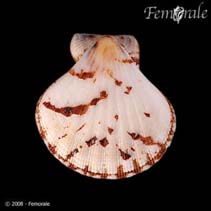
Shell solid, small, nearly as long as high, inequivalve, the outline somewhat elongate dorsally and subcircular ventrally. Both valves convex, the right (lower) valve more inflated than the left (upper) valve which is moderately flattened towards the umbo. Ears small, subequal in size and shape. Right anterior ear with an obsolete anteroventral byssal notch, devoid of ctenolium. Outer sculpture of each valve with about 9 to 11 rounded radial folds, with numerous, much smaller secondary radial riblets that are finely lamellous on ribs or interspaces; transverse lamellous sculpture delicate and easily eroded on top of ribs. Hinge line short, about 1/3 to 1/2 of shell length, with rather strong oblique ridges and pits on either side of internal ligament. Interior of valves shiny , with a flattened radial sculpture corresponding with the outer folds. Colour: outside of shell off-white to beige, variously mottled with chestnut brown, tan or reddish purple, mainly on the left valve which is more vividly coloured than the often nearly uniform cream right valve. Interior whitish, frequently tinged with dark brown on hinge areas and broad rims, in 1 or both valves.
Lying free on sandy bottoms in intertidal and sublittoral areas (Ref. 348). Common in coral reef areas (Ref. 128042).
Cycle de vie et comportement reproducteur
Maturité | Reproduction | Frai | Œufs | Fécondité | Larves
Members of the class Bivalvia are mostly gonochoric, some are protandric hermaphrodites. Life cycle: Embryos develop into free-swimming trocophore larvae, succeeded by the bivalve veliger, resembling a miniature clam.
Poutiers, J.M. 1998 Bivalves. Acephala, Lamellibranchia, Pelecypoda. p. 123-362. In Carpenter, K. E. and V. H. Niem. 1998. FAO species identification guide for fishery purposes. The living marine resources of the Western Central Pacific. Volume 1. Seaweeds, corals, bivalves, and gastropods. Rome, FAO. (Réf. 348)
Statut dans la liste rouge de l'IUCN
(Réf. 130435: Version 2025-2 (Global))
statut CITES (Réf. 108899)
Not Evaluated
Not Evaluated
Menace pour l'homme
Harmless
Utilisations par l'homme
FAO - Publication: search | FishSource |
Outils
Plus d'informations
Écologie trophiqueAliments (proies)
Composition du régime alimentaire
Consommation alimentaire
Prédateurs
Dynamique des populationsCroissance
Âges / tailles maximales
Longueur-poids rel.
Rel. longueur-longueur.
Fréquences de longueurs
Conversion de masse
Abondance
Cycle de vieReproductionMaturitéFéconditéFraiŒufsDéveloppement de l'œufLarves PhysiologieConsommation d'oxygène
Liées à l'hommeTimbres, pièces de monnaie, divers
Sources Internet
Estimations basées sur des modèles
Vulnérabilité de la pêche
(Réf. 71543) |
Low vulnerability (10 of 100). |
Catégorie de prix
(Réf. 80766): |
Medium. |