Demospongiae |
Dictyoceratida |
Spongiidae
Entorno: milieu / zona climática / rango de profundidad / gama de distribución
Ecología
Sessile; rango de profundidad 0 - 200 m (Referencia 124162). Subtropical; 46°N - 25°N, 19°W - 36°E
Eastern Central Atlantic and the Mediterranean: Canary Islands, north to Liguria, Italy, east to Ras Ech-Chekkaa, Lebanon.
Longitud en la primera madurez / Tamaño / Peso / Edad
Madurez: Lm ? range ? - ? cm Max length : 30.0 cm WD macho / no sexado; (Referencia 363)
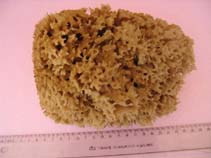
Massive sponge; on surface equipped with conules very irregularly dispersed. A thin and generally smooth ectosome covers the surface gaps. Sponge: traversed great gaps méandriformes. Rare primary fibers: 0.0060 to 0.01 cm diameter; formed by the anastomoses of several fibers at their end in the conules; and containing foreign bodies. Secondary fibers: 0.0025 to 0.003 cm diameter. Coloring: darkish gray with yellowish on the surface, often brown white orange inside (Ref. 363).
Minimum depth based from Ref. 363. Importance: It is the principal species currently exploited. The essence of the production comes from Tunisia. It is used for the domestic uses, the toilet and certain industries (Ref. 363). Common between 0.5 and 30 m of depth, would go down up to 80 m to Libya (Ref. 363). Found in caves, coralligenous communities, seagrass meadows, and rocky, detritic, and muddy bottom in depths of 1 to 200 meters (Ref. 124162).
Ciclo vital y comportamiento de apareamiento
Madurez | Reproducción | Puesta | Huevos | Fecundidad | Larva
Members of the class Demospongiae are hermaphroditic. Life cycle: The zygote develops into parenchymella larva (free-swimming) before settling down on a substrate where it grows into a young sponge.
Vacelet, J. 1987 Éponges. p. 137-148. In Fischer, W., M. L. Bauchot and M. Schneider. 1987. Fiches FAO d' identification des espèces pour les besoins de la pêche. (Revision 1). Méditerranée et mer Noire. Zone de pêche 37. Volume I. Végëtaux et Invertébrés. Publication préparée par la FAO, résultant d'un accord entre la FAO et la Commission des Communautés européennes (Project GCP/INT/422/EEC) financëe conjointement par ces deux organisations. Rome, FAO, Vol.1. (Referencia 363)
Situación en la Lista Roja de la UICN
(Referencia 130435: Version 2025-2 (Global))
Estatus CITES (Referencia 108899)
Not Evaluated
CMS (Referencia 116361)
Not Evaluated
Amenaza para el ser humano
Harmless
Usos humanos
Pesquerías: muy comercial
FAO - Publication: search | FishSource |
Herramientas
Más información
Ecología TróficaAlimentos (presas)
Composición de la dieta
consumo de alimento
Despredadores
Dinámica de la poblaciónCrecimientoEdades / tallas máximasLongitud-peso rel.Longitud-longitud rel.Longitud-frecuenciasConversión de masasAbundancia Ciclo de vidaReproducciónMadurezFecundidadPuestaHuevosDesarrollo de los huevosLarva FisiologíaConsumo del oxígeno
Relacionados con el ser humanoSellos, monedas, varios
Fuentes de Internet
Estimaciones basadas en modelos
Vulnerabilidad pesquera
(Referencia 71543) |
Low vulnerability (20 of 100). |
Categoría de precios
(Referencia 80766): |
Unknown. |