Demospongiae |
Dictyoceratida |
Spongiidae
Environnement : milieu / zone climatique / profondeur / gamme de distribution
Écologie
Sessile; profondeur 4 - 100 m (Réf. 363), usually 4 - 60 m (Réf. 363). Subtropical
Northeast Atlantic and Mediterranean.
Longueur à la première maturité / Taille / Poids / Âge
Maturité: Lm ? range ? - ? cm Max length : 100.0 cm WD mâle / non sexé; (Réf. 363)
Description synthétique
Morphologie
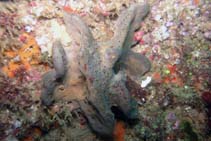
Sponge out of thick blade: 0.6 to 2 cm; sometimes cut out or folded up on it, often forming a more or less complete cut. One of the faces, the intern on the specimens out of cut, carries many osculus of small size, rather regularly laid out, towards which converge of small exhaling channels surface. Conules: small size; rather regular. Ectosome often reinforced by an arenaceous network. Composite primary fibers: 5 - 8 cm diameter; with foreign bodies. Secondary fibers: 0.0025 to 0.0035 cm; with sometimes a fine fiber network from 0.0006 to 0.001 cm on the surface. Color: dark gray with more or less dark chestnut.
Species very good fair average quality, formerly much used in industry (polishing of the ices). Restricted production; collected at decorative ends (Ref. 363). Association: Often parasitized by the cirripede Acasta spongites (Ref. 363).
Cycle de vie et comportement reproducteur
Maturité | Reproduction | Frai | Œufs | Fécondité | Larves
Members of the class Demospongiae are hermaphroditic. Life cycle: The zygote develops into parenchymella larva (free-swimming) before settling down on a substrate where it grows into a young sponge.
Vacelet, J. 1987 Éponges. p. 137-148. In Fischer, W., M. L. Bauchot and M. Schneider. 1987. Fiches FAO d' identification des espèces pour les besoins de la pêche. (Revision 1). Méditerranée et mer Noire. Zone de pêche 37. Volume I. Végëtaux et Invertébrés. Publication préparée par la FAO, résultant d'un accord entre la FAO et la Commission des Communautés européennes (Project GCP/INT/422/EEC) financëe conjointement par ces deux organisations. Rome, FAO, Vol.1. (Réf. 363)
Statut dans la liste rouge de l'IUCN
(Réf. 130435: Version 2025-2 (Global))
statut CITES (Réf. 108899)
Not Evaluated
Not Evaluated
Menace pour l'homme
Harmless
Utilisations par l'homme
Pêcheries: hautement commercial
FAO - Publication: search | FishSource |
Outils
Plus d'informations
Écologie trophiqueAliments (proies)
Composition du régime alimentaire
Consommation alimentaire
Prédateurs
Dynamique des populationsCroissanceÂges / tailles maximalesLongueur-poids rel.Rel. longueur-longueur.Fréquences de longueursConversion de masseAbondance Cycle de vieReproductionMaturitéFéconditéFraiŒufsDéveloppement de l'œufLarves PhysiologieConsommation d'oxygène
Liées à l'hommeTimbres, pièces de monnaie, divers
Sources Internet
Estimations basées sur des modèles
Vulnérabilité de la pêche
(Réf. 71543) |
High vulnerability (60 of 100). |
Catégorie de prix
(Réf. 80766): |
Unknown. |