Malacostraca |
Stomatopoda |
Lysiosquillidae
Lingkungan: lingkungan / zona iklim / kisaran kedalaman / jangkauan distribusi
Ekologi
Benthic; kisaran kedalaman 0 - 30 m (Acuan 436). Tropical
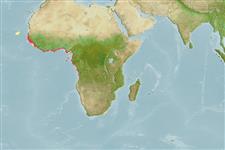
Off West Africa, from the Cape Verde Islands; Senegal to Angola.
Panjang pada saat jatuh tempo pertama / Ukuran / Berat / umur
Kematangan: Lm ? range ? - ? cm Max length : 27.0 cm BL jantan/; (Acuan 417); common length : 20.0 cm BL jantan/; (Acuan 436)
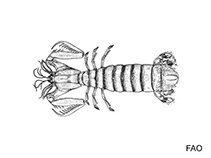
A moderately large to very large stomatopod. Body conspicuously flattened, smooth, lacking ridges or spines except for the tail region; 6th abdominal segment and telson; which is prickly with small bumps or tubercles. Telson with a raised, elongate boss medially, but without a median ridge. Rostral plate broader than long, with a low median crest on its anterior third. Claws very large, often longer than carapace and armed with 10 to 12 sharp spines on the terminal segment. Color: marked with light and dark cross bands (Ref. 436).
Found in shallow water (Ref. 436).
Siklus hidup dan perilaku kawin
Kematangan | Reproduksi, perkembang biakan | Pemijahan | telur-telur | Fekunditas | Larva
Some members of the order Stomatopoda pair for life and some come together only to mate. Males produce sperm ducts rather than spermatophores; females can brood a maximum of 50,000 eggs. Life cycle: Eggs hatch to a planktonic zoea which lasts for 3 months.
rujukan utama
Acuan | Koordinator | mitra
Schneider, W. 1990 FAO species identification sheets for fishery purposes. Field guide to the commercial marine resources of the Gulf of Guinea. Prepared and published with the support of the FAO Regional Office for Africa. Rome: FAO. 268 p. (Acuan 417)
Status IUCN Red List
(Acuan 130435: Version 2025-2 (Global))
status CITES (Acuan 108899)
Not Evaluated
Not Evaluated
ancaman kepada manusia
Harmless
penggunaan manusia
FAO - Publication: search | FishSource |
Alat, peralatan
informasi lanjut
Ekologi trofikItem makanan (mangsa)
Komposisi makanan
Konsumsi makanan
Pemangsa
Dinamika populasiPertumbuhanMaks. usia / ukuranPanjang-berat rel.Panjang-panjang rel.ukuran frekuensiKonversi massaKelimpahan FisiologiKonsumsi oksigen
Yang berhubungan dengan manusiaPerangko, koin, dll.
Sumber internet
Estimasi berdasarkan model
Kerentanan Penangkapan Ikan
(Acuan 71543) |
Low vulnerability (17 of 100). |
kategori harga
(Acuan 80766): |
Unknown. |