Malacostraca |
Stomatopoda |
Lysiosquillidae
Milieu: milieu / Klimaatzone / Diepte / verspreidingsgebied
Ecologie
Benthic; diepte 0 - 30 m (Ref. 436). Tropical
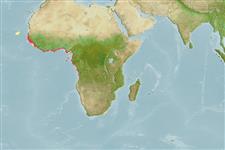
Off West Africa, from the Cape Verde Islands; Senegal to Angola.
Lengte bij maturiteit / Grootte / Gewicht / Leeftijd
Maturiteit: Lm ? range ? - ? cm Max length : 27.0 cm BL mannelijk / geslacht onbekend; (Ref. 417); common length : 20.0 cm BL mannelijk / geslacht onbekend; (Ref. 436)
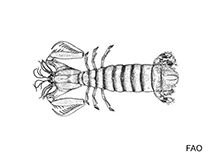
A moderately large to very large stomatopod. Body conspicuously flattened, smooth, lacking ridges or spines except for the tail region; 6th abdominal segment and telson; which is prickly with small bumps or tubercles. Telson with a raised, elongate boss medially, but without a median ridge. Rostral plate broader than long, with a low median crest on its anterior third. Claws very large, often longer than carapace and armed with 10 to 12 sharp spines on the terminal segment. Color: marked with light and dark cross bands (Ref. 436).
Found in shallow water (Ref. 436).
Levenscyclus en paargedrag
Maturiteit | Voortplanting | Paaien | Eieren | Fecunditeit | Larven
Some members of the order Stomatopoda pair for life and some come together only to mate. Males produce sperm ducts rather than spermatophores; females can brood a maximum of 50,000 eggs. Life cycle: Eggs hatch to a planktonic zoea which lasts for 3 months.
Schneider, W. 1990 FAO species identification sheets for fishery purposes. Field guide to the commercial marine resources of the Gulf of Guinea. Prepared and published with the support of the FAO Regional Office for Africa. Rome: FAO. 268 p. (Ref. 417)
Status op de Rode Lijst van het IUCN
(Ref. 130435: Version 2025-2 (Global))
CITES status (Ref. 108899)
Not Evaluated
Not Evaluated
Gevaar voor de mens
Harmless
Gebruik door de mens
FAO - Publication: search | FishSource |
Tools
Meer informatie
Trofische ecologieVoedsel (prooien)
Dieetsamenstelling
Voedselconsumptie
Predatoren
LevenscyclusVoortplantingMaturiteitFecunditeitPaaienEierenOntwikkeling van de eierenLarven FysiologieZuurstofverbruik
Menselijk gerelateerdPostzegels, munten, diversen.
Internetbronnen
Schattingen op basis van modellen
Kwetsbaarheid van de visserij
(Ref. 71543) |
Low vulnerability (17 of 100). |
Prijsklasse
(Ref. 80766): |
Unknown. |