Gastropoda |
Anaspidea |
Notarchidae
Umwelt: Milieu / Klimazone / Tiefenbereich / Verbreitungsgebiet
Ökologie
Benthic; tiefenbereich 0 - 30 m (Ref. 7727). Tropical; 15°C - 30°C (Ref. 81113)
Circumglobal tropical, temperate seas and the Mediterranean Sea.
Länge bei der ersten Reifung / Größe / Gewicht / Alter
Geschlechtsreife: Lm ? range ? - ? cm Max length : 25.0 cm TL Männchen/unbestimmt; (Ref. 81112)
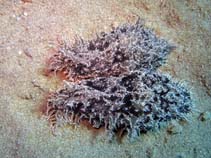
This is a medium- to large-sized benthic opisthobranch mollusc. The body is variably colored, grayish-green to white-tan with dark brown blotches and spots, compact and rounded, with distinct head and neck regions evident. The body is also covered with numerous long, branching fleshy papillae that give the animal its ragged appearance. The gill is covered by a pair of fleshy parapodia. Two long retractile olfactory tentacles called rhinophores occur on the head, and also two fleshy enrolled oral tentacles occur at each side of the mouth. Adults completely lack a shell.
Assumed maximum length from Ref. 844. Commonly found in estuaries and tidal swimming pools (Ref. 866). Known from depths of 0 to 30 m (Ref. 7727). It is known to secrete purple ink which is produced from the purple gland, speculated to be a defensive decoy (Ref. 81111). The ink may also be a metabolic by-product in response to eating algae, particularly red algae, as observed with the species under the genus Aplysia (Ref. 81114). Primarily feeds on cyanophytes and diatom mats and films found on sand, mud and other benthic substrata; facultatively it consumes Ectocarpus and Enteromorpha spp. (Ref. 81111).
Lebenszyklus und Paarungsverhalten
Geschlechtsreife | Fortpflanzung | Ablaichen | Eier | Fruchtbarkeit | Larven
This is a cross-fertilizing simultaneous hermaphrodite. This is done through internal fertilization wherein one individual transfers its sperm by its eversible penis on the right side of the head to the gonopore of the other individual on the dorsal side. It then lays spaghetti-like benthic egg masses in orange, yellow, green, or brown colors. This is comprised of capsules that contains 1 to 20 eggs. Sexual maturity is attained at the age of 2 to 3 months. Reproductive season is still undefined (Ref. 125338). Come inshore during March and April to lay its eggs. Copulation goes from several hours to several days. Once the eggs are laid, the adults return to shallow waters to die (Ref. 125338).
Burn, R. 2006 A checklist and bibliography of the Opisthobranchia (Mollusca: Gastropoda) of Victoria and the Bass Strait, southeastern Australia. Museum Victoria Science Reports 10:1-42. (Ref. 7727)
IUCN Rote Liste Status
(Ref. 130435: Version 2025-2 (Global))
CITES Status (Ref. 108899)
Not Evaluated
Not Evaluated
Bedrohung für Menschen
Nutzung durch Menschen
FAO - Publication: search | FishSource |
Tools
Mehr Information
PopulationsdynamikWachstumMax. Alter/GrößenLänge-Gewicht-Rel.Länge-Länge-Verhältnis.LängenhäufigkeitenMassenkonvertierungDichte LebenszyklusFortpflanzungGeschlechtsreifeFruchtbarkeitAblaichenEierEientwicklungLarven PhysiologieSauerstoffverbrauch
MenschenbezogenBriefmarken, Münzen, Verschiedenes.
Internet Quellen
Schätzungen auf der Grundlage von Modellen
Anfälligkeit der Fischerei
(Ref. 71543) |
Low vulnerability (15 of 100). |
Preiskategorie
(Ref. 80766): |
Unknown. |