Gastropoda |
Anaspidea |
Notarchidae
Môi trường: môi trường / vùng khí hậu / Mức độ sâu / phạm vi phân phối
Sinh thái học
Benthic; mức độ sâu 0 - 30 m (Tài liệu tham khảo 7727). Tropical; 15°C - 30°C (Tài liệu tham khảo 81113)
Circumglobal tropical, temperate seas and the Mediterranean Sea.
Chiều dài lúc trưởng thành đầu tiên / Bộ gần gũi / Khối lượng (Trọng lượng) / Tuổi
Chín muồi sinh dục: Lm ? range ? - ? cm Max length : 25.0 cm TL con đực/không giới tính; (Tài liệu tham khảo 81112)
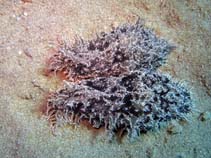
This is a medium- to large-sized benthic opisthobranch mollusc. The body is variably colored, grayish-green to white-tan with dark brown blotches and spots, compact and rounded, with distinct head and neck regions evident. The body is also covered with numerous long, branching fleshy papillae that give the animal its ragged appearance. The gill is covered by a pair of fleshy parapodia. Two long retractile olfactory tentacles called rhinophores occur on the head, and also two fleshy enrolled oral tentacles occur at each side of the mouth. Adults completely lack a shell.
Assumed maximum length from Ref. 844. Commonly found in estuaries and tidal swimming pools (Ref. 866). Known from depths of 0 to 30 m (Ref. 7727). It is known to secrete purple ink which is produced from the purple gland, speculated to be a defensive decoy (Ref. 81111). The ink may also be a metabolic by-product in response to eating algae, particularly red algae, as observed with the species under the genus Aplysia (Ref. 81114). Primarily feeds on cyanophytes and diatom mats and films found on sand, mud and other benthic substrata; facultatively it consumes Ectocarpus and Enteromorpha spp. (Ref. 81111).
Vòng đời và hành vi giao phối
Chín muồi sinh dục | Sự tái sinh sản | Đẻ trứng | Các trứng | Sự sinh sản | Ấu trùng
This is a cross-fertilizing simultaneous hermaphrodite. This is done through internal fertilization wherein one individual transfers its sperm by its eversible penis on the right side of the head to the gonopore of the other individual on the dorsal side. It then lays spaghetti-like benthic egg masses in orange, yellow, green, or brown colors. This is comprised of capsules that contains 1 to 20 eggs. Sexual maturity is attained at the age of 2 to 3 months. Reproductive season is still undefined (Ref. 125338). Come inshore during March and April to lay its eggs. Copulation goes from several hours to several days. Once the eggs are laid, the adults return to shallow waters to die (Ref. 125338).
Burn, R. 2006 A checklist and bibliography of the Opisthobranchia (Mollusca: Gastropoda) of Victoria and the Bass Strait, southeastern Australia. Museum Victoria Science Reports 10:1-42. (Tài liệu tham khảo 7727)
Tình trạng Sách đỏ IUCN
(Tài liệu tham khảo 130435: Version 2025-2 (Global))
tình trạng CITES (Tài liệu tham khảo 108899)
Not Evaluated
CMS (Tài liệu tham khảo 116361)
Not Evaluated
Mối đe dọa đối với con người
Sử dụng của con người
FAO - Publication: search | FishSource |
Các công cụ
Thêm thông tin
Biến động dân sốSự sinh trưởngĐộ tuổi / kích thước tối đaChiều dài-trọng lượng tương đốiChiều dài-chiều dài tương đối.Chiều dài-tần sốChuyển đổi khối lượngSự phong phú Vòng đờiSự tái sinh sảnChín muồi sinh dụcSự sinh sảnĐẻ trứngCác trứngSự phát triển của trứngẤu trùng Sinh lý họcThành phần ô-xy
Liên quan đến con ngườiTem, tiền xu, v.v.
Các nguồn internet
Ước tính dựa trên mô hình
Sự dễ bị tổn thương của nghề đánh cá
(Tài liệu tham khảo 71543) |
Low vulnerability (15 of 100). |
Loại giá
(Tài liệu tham khảo 80766): |
Unknown. |