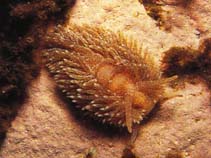
Gastropoda |
Nudibranchia |
Aeolidiidae
Environnement : milieu / zone climatique / profondeur / gamme de distribution
Écologie
Benthic; profondeur 0 - 380 m (Réf. 83435). Temperate; 85°N - 57°S, 180°W - 43°E
Arctic, Atlantic, Eastern Pacific and the Mediterranean Sea. Subtropical to polar.
Longueur à la première maturité / Taille / Poids / Âge
Maturité: Lm ? range ? - ? cm Max length : 10.0 cm TL mâle / non sexé; (Réf. 7726)
Assumed maximum length from Ref. 822. Known from intertidal to deep waters, in large aggregations of thirty or more individual adults (Ref. 7726). Free-living (Ref. 3123). Generally for group, planktonic and minute detrital food items through either suspension or deposit feeding (Ref. 87872). Feeds on various sea anemones (Ref. 822), particularly frilled anemone (Ref. 7726).
Cycle de vie et comportement reproducteur
Maturité | Reproduction | Frai | Œufs | Fécondité | Larves
Sexes are separate but are seldom conspicuously different externally, simultaneous hermaphrodites yet self-fertilization is prevented due to various morphological, physiological, or behavioral mechanisms; generally, marine gastropods shed their eggs (Ref. 87872).
Turgeon, D.D., J.F. Quinn Jr., A.E. Bogan, E.V. Coan, F.G. Hochberg, W.G. Lyons, P.M. Mikkelsen, R.J. Neves, C.F.E. Roper, G. Rosenberg, B. Roth, A. Scheltema, F.G. Thompson, M. Vecchione and J.D. Willams 1998 Common and scientific names of aquatic invertebrates from the United States and Canada: Mollusks, 2nd ed. American Fisheries Society (Special publication 26), Bethesda, Maryland. 526 p. (Réf. 1667)
Statut dans la liste rouge de l'IUCN
(Réf. 130435: Version 2025-2 (Global))
statut CITES (Réf. 108899)
Not Evaluated
Not Evaluated
Menace pour l'homme
Utilisations par l'homme
FAO - Publication: search | FishSource |
Outils
Plus d'informations
Dynamique des populationsCroissance
Âges / tailles maximales
Longueur-poids rel.
Rel. longueur-longueur.
Fréquences de longueurs
Conversion de masse
Abondance
Cycle de vieReproductionMaturitéFéconditéFraiŒufsDéveloppement de l'œufLarves PhysiologieConsommation d'oxygène
Liées à l'hommeTimbres, pièces de monnaie, divers
Sources Internet
Estimations basées sur des modèles
Vulnérabilité de la pêche
(Réf. 71543) |
Low vulnerability (10 of 100). |
Catégorie de prix
(Réf. 80766): |
Unknown. |