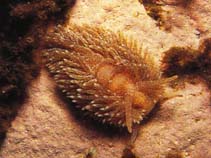
Gastropoda |
Nudibranchia |
Aeolidiidae
สิ่งแวดล้อม : สิ่งแวดล้อม / เขตภูมิอากาศ / ระดับความลึก / ระยะการกระจายสินค้า
นิเวศวิทยา
Benthic; ระดับความลึก 0 - 380 m (อ้างอิง 83435). Temperate; 85°N - 57°S, 180°W - 43°E
Arctic, Atlantic, Eastern Pacific and the Mediterranean Sea. Subtropical to polar.
ความยาวเมื่อครบกำหนดครั้งแรก / ขนาด / น้ำหนัก / อายุ
วัยเจริญพันธุ์: Lm ? range ? - ? cm Max length : 10.0 cm TL เพศผู้/กระเทย; (อ้างอิง 7726)
Assumed maximum length from Ref. 822. Known from intertidal to deep waters, in large aggregations of thirty or more individual adults (Ref. 7726). Free-living (Ref. 3123). Generally for group, planktonic and minute detrital food items through either suspension or deposit feeding (Ref. 87872). Feeds on various sea anemones (Ref. 822), particularly frilled anemone (Ref. 7726).
วงจรชีวิตและพฤติกรรมการผสมพันธุ์
วัยเจริญพันธุ์ | การสืบพันธุ์ | การวางไข่ | เซลสืบพันธ์ของเพศเมีย(ไข่) | ความดกของไข่ | ตัวอ่อน
Sexes are separate but are seldom conspicuously different externally, simultaneous hermaphrodites yet self-fertilization is prevented due to various morphological, physiological, or behavioral mechanisms; generally, marine gastropods shed their eggs (Ref. 87872).
Turgeon, D.D., J.F. Quinn Jr., A.E. Bogan, E.V. Coan, F.G. Hochberg, W.G. Lyons, P.M. Mikkelsen, R.J. Neves, C.F.E. Roper, G. Rosenberg, B. Roth, A. Scheltema, F.G. Thompson, M. Vecchione and J.D. Willams 1998 Common and scientific names of aquatic invertebrates from the United States and Canada: Mollusks, 2nd ed. American Fisheries Society (Special publication 26), Bethesda, Maryland. 526 p. (อ้างอิง 1667)
สถานะบัญชีแดงของ IUCN
(อ้างอิง 130435: Version 2025-2 (Global))
สถานะไซเตส (อ้างอิง 108899)
Not Evaluated
CMS (อ้างอิง 116361)
Not Evaluated
ภัยคุกคามต่อมนุษย์
การใช้ของมนุษย์
FAO - Publication: search | FishSource |
เครื่องมือ
ข้อมูลเพิ่มเติม
พลวัตของประชากรการเจริญเติบโต
อายุสูงสุด / ขนาด
ความยาว-น้ำหนักสัมพันธ์
ความยาว-ความยาวสัมพันธ์
ความยาว-ความถี่
การแปลงมวล
อุดมสมบรูณ์
วงจรชีวิตการสืบพันธุ์วัยเจริญพันธุ์ความดกของไข่การวางไข่เซลสืบพันธ์ของเพศเมีย(ไข่)การพัฒนาไข่ตัวอ่อน เกี่ยวข้องกับมนุษย์แสตมป์ เหรียญ อื่นๆ
แหล่งที่มาจากอินเตอร์เน็ต
การประมาณค่าตามแบบจำลอง
ความเสี่ยงต่อการตกปลา
(อ้างอิง 71543) |
Low vulnerability (10 of 100). |
หมวดหมู่ราคา
(อ้างอิง 80766): |
Unknown. |