Bivalvia |
Cardiida |
Psammobiidae
Umwelt: Milieu / Klimazone / Tiefenbereich / Verbreitungsgebiet
Ökologie
Benthic; süßwasser; brackwasser; pH range: ? - 15.0; tiefenbereich 0 - 30 m (Ref. 348). Tropical
Indo-West Pacific: from East Africa, to the Philippines; north to Japan and south to northern Queensland.
Länge bei der ersten Reifung / Größe / Gewicht / Alter
Geschlechtsreife: Lm ?, range 4 - ? cm Max length : 7.0 cm SHL Männchen/unbestimmt; (Ref. 348); common length : 5.5 cm SHL Männchen/unbestimmt; (Ref. 348)
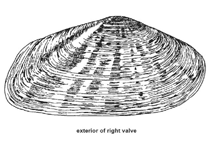
Occurs in extensive beds at intertidal and shallow subtidal levels, often in bays and near mangroves. Shell form varies considerably with growth (Ref. 348).
Hermaphoditism occurs in some species. Breeding is continuous throughout the year (Ref. 107755). Major and minor spawning peak occurs between December-January and May to June, respectively (Ref. 82297).
Poutiers, J.M. 1998 Bivalves. Acephala, Lamellibranchia, Pelecypoda. p. 123-362. In Carpenter, K. E. and V. H. Niem. 1998. FAO species identification guide for fishery purposes. The living marine resources of the Western Central Pacific. Volume 1. Seaweeds, corals, bivalves, and gastropods. Rome, FAO. (Ref. 348)
IUCN Rote Liste Status
(Ref. 130435: Version 2025-2 (Global))
CITES Status (Ref. 108899)
Not Evaluated
Not Evaluated
Bedrohung für Menschen
Harmless
Nutzung durch Menschen
FAO - Publication: search | FishSource |
Tools
Mehr Information
Trophische ÖkologieLebensmittel (Beutetiere)
Nahrungszusammensetzung
Nahrungsaufnahme
Räuber
PhysiologieSauerstoffverbrauch
MenschenbezogenBriefmarken, Münzen, Verschiedenes.
Internet Quellen
Schätzungen auf der Grundlage von Modellen
Widerstandsfähigkeit
(Ref. 69278): |
hoch, Verdopplung der Population dauert weniger als 15 Monate. (K=0.65-1) |
Anfälligkeit der Fischerei
(Ref. 71543) |
Low vulnerability (10 of 100). |
Preiskategorie
(Ref. 80766): |
Unknown. |