Gastropoda |
Cycloneritida |
Neritidae
Miljö: miljö / Klimatzon / djupintervall / distributionsområde
Ekologi
Benthic; brackvatten; djupintervall 0 - 2 m (Ref. 100219). Tropical
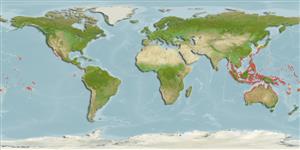
Indo-Pacific: from the Gulf of Bengal to western Polynesia; north to southern Japan and south to northern Queensland.
Längd vid första mognad / Storlek / Vikt / Ålder
Könsmognad: Lm ? range ? - ? cm Max length : 3.5 cm SHL hane/ej könsbestämd; (Ref. 349); common length : 2.0 cm SHL hane/ej könsbestämd; (Ref. 349)
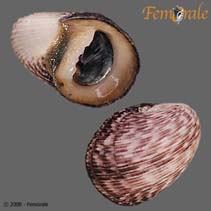
This species can be distinguished by the following characters: shell with depressed spire; presence of 30 alternating spiral ribs on the outer surface; columella deck smooth, with single elongate ridge and 3-7 denticles at the center. Colouration: exterior dull, black, with white or reddish-brown axial streaks. Operculum calcareous, smooth, black or grey (Ref. 128042).
Locally common. Occasionally collected for food and shellcraft (Ref. 349). Maximum depth from Ref. 114677. Inhabits rocks near muddy mangrove areas (Ref. 799). Found attached on root or trunk of mangrove tree (Ref. 128042).
Livscykel och parningsbeteende
Könsmognad | Reproduktion | Lek | Ägg | Fekunditet | Larver
Members of the order Neritopsina are mostly gonochoric and broadcast spawners. Life cycle: Embryos develop into planktonic trocophore larvae and later into juvenile veligers before becoming fully grown adults.
Poutiers, J.M. 1998 Gastropods. p. 363-648. In Carpenter, K. E. and V. H. Niem. 1998. FAO species identification guide for fishery purposes. The living marine resources of the Western Central Pacific. Volume 1. Seaweeds, corals, bivalves, and gastropods. Rome, FAO. (Ref. 349)
Status på IUCN:s rödlista
(Ref. 130435: Version 2025-2 (Global))
CITES-status (Ref. 108899)
Not Evaluated
Not Evaluated
Hot mot människor
Harmless
Mänskliga användningsområden
FAO - Publication: search | FishSource |
Verktyg
Ytterligare information
Trofisk ekologiLivsmedelsartiklar (preys)
Födosammansättning
Födointag
Predatorer
LivscykelReproduktionKönsmognadFekunditetLekÄggUtveckling av äggLarver MänniskorelateradFrimärken, mynt, diverse.
Internet-källor
Uppskattningar baserade på modeller
Sårbarhet i fisket
(Ref. 71543) |
Low vulnerability (10 of 100). |
Priskategori
(Ref. 80766): |
Unknown. |