Gastropoda |
Littorinimorpha |
Cypraeidae
Environnement : milieu / zone climatique / profondeur / gamme de distribution
Écologie
Benthic; profondeur ? - 10 m (Réf. 126058). Tropical
Indo-Pacific.
Longueur à la première maturité / Taille / Poids / Âge
Maturité: Lm ? range ? - ? cm Max length : 10.5 cm SHL mâle / non sexé; (Réf. 349); common length : 8.0 cm SHL mâle / non sexé; (Réf. 349)
Description synthétique
Morphologie
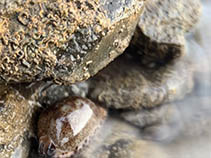
Shell is smooth and shiny, with an elliptical to egg-like shape. Brown, with distinctive variable fine dark brown line patterns on the dorsal surface and black spots on the two sides. Ventral surface appears cream to gray. Aperture is long and narrow, without an operculum. Both upper and lower lips are lined with small teeth.
Collected for food by coastal populations in many areas. Shell used in shellcraft or sold for collections (Ref. 349). Found in coral reef and rocky habitats, common in shallow water and tide pools (Ref. 128042), under slabs and stones and in caverns of the outer edge of coral reefs. Inhabits well-aerated waters. Mainly nocturnal (Ref. 349). Members of the family Cypraeidae are primarily carnivores (Ref. 67623). Reported from Hong Kong to be found on the ceilings and walls of submarine caves (Ref. 126058).
Cycle de vie et comportement reproducteur
Maturité | Reproduction | Frai | Œufs | Fécondité | Larves
Members of the order Neotaenioglossa are mostly gonochoric and broadcast spawners. Life cycle: Embryos develop into planktonic trocophore larvae and later into juvenile veligers before becoming fully grown adults.
Poutiers, J.M. 1998 Gastropods. p. 363-648. In Carpenter, K. E. and V. H. Niem. 1998. FAO species identification guide for fishery purposes. The living marine resources of the Western Central Pacific. Volume 1. Seaweeds, corals, bivalves, and gastropods. Rome, FAO. (Réf. 349)
Statut dans la liste rouge de l'IUCN
(Réf. 130435: Version 2025-2 (Global))
statut CITES (Réf. 108899)
Not Evaluated
Not Evaluated
Menace pour l'homme
Harmless
Utilisations par l'homme
Pêcheries: commercial
FAO - Publication: search | FishSource |
Outils
Plus d'informations
Écologie trophiqueAliments (proies)
Composition du régime alimentaire
Consommation alimentaire
Prédateurs
Dynamique des populations Cycle de vieReproductionMaturitéFéconditéFraiŒufsDéveloppement de l'œufLarves PhysiologieConsommation d'oxygène
Liées à l'hommeTimbres, pièces de monnaie, divers
Sources Internet
Estimations basées sur des modèles
Vulnérabilité de la pêche
(Réf. 71543) |
Low vulnerability (10 of 100). |
Catégorie de prix
(Réf. 80766): |
Unknown. |