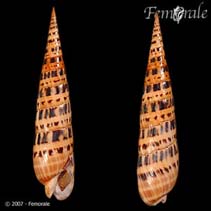
Gastropoda |
Neogastropoda |
Terebridae | Terebrinae
Environnement : milieu / zone climatique / profondeur / gamme de distribution
Écologie
Benthic; profondeur 0 - 210 m (Réf. 349). Tropical; 33°N - 30°S, 34°E - 110°W
Indo-Pacific: from East Africa, Sudan, Yemen, India, Maldives, Andaman and Nicobar Islands, Cocos (Keeling) and Christmas Islands to Pitcairn, north to Japan and Hawaii, south to Australia, including Socorro Island (Mexico).
Longueur à la première maturité / Taille / Poids / Âge
Maturité: Lm ? range ? - ? cm Max length : 27.5 cm SHL mâle / non sexé; (Réf. 349); common length : 16.0 cm SHL mâle / non sexé; (Réf. 349)
Commonly collected in many areas, both for its edible flesh and for its shell which has been used as a tool in many of the South Pacific cultures (Ref. 349). Leaves characteristic wide tracks on sand when moving. Occurs at the low tide mark (Ref. 349). Intertidal (Ref. 106792). Found on coarse and fine sand. Usually crawls under the sand surface with the foot buried deeply in the sand (Ref. 106669). Feeds on an enteropneust and polychaete (Ref. 106669).
Cycle de vie et comportement reproducteur
Maturité | Reproduction | Frai | Œufs | Fécondité | Larves
This species is a non-broadcast spawner. Life cycle does not include trocophore stage. Also Ref. 833.
Poutiers, J.M. 1998 Gastropods. p. 363-648. In Carpenter, K. E. and V. H. Niem. 1998. FAO species identification guide for fishery purposes. The living marine resources of the Western Central Pacific. Volume 1. Seaweeds, corals, bivalves, and gastropods. Rome, FAO. (Réf. 349)
Statut dans la liste rouge de l'IUCN
(Réf. 130435: Version 2025-2 (Global))
statut CITES (Réf. 108899)
Not Evaluated
Not Evaluated
Menace pour l'homme
Harmless
Utilisations par l'homme
Pêcheries: commercial
FAO - Publication: search | FishSource | Sea Around Us
Outils
Plus d'informations
Dynamique des populationsCroissanceÂges / tailles maximalesLongueur-poids rel.Rel. longueur-longueur.Fréquences de longueursConversion de masseAbondance Cycle de vieReproductionMaturitéFéconditéFraiŒufsDéveloppement de l'œufLarves PhysiologieConsommation d'oxygène
Liées à l'hommeTimbres, pièces de monnaie, divers
Sources Internet
Estimations basées sur des modèles
Vulnérabilité de la pêche
(Réf. 71543) |
Low vulnerability (18 of 100). |
Catégorie de prix
(Réf. 80766): |
Unknown. |
Nutrients
|
Calcium = 126 [75, 177] mg/100g; Iron = 4.79 [1.67, 7.92] mg/100g; Protein = 15.9 [14.8, 16.9] %; Omega3 = 0.331 [0.263, 0.400] g/100g; Selenium = 57.8 [48.5, 67.2] μg/100g; VitaminA = 0 μg/100g; Zinc = 1.97 [0.92, 3.02] mg/100g (wet weight); based on nutrient studies. |