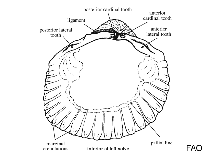
Bivalvia |
Cardiida |
Cardiidae
Environnement : milieu / zone climatique / profondeur / gamme de distribution
Écologie
Benthic; profondeur 10 - 237 m (Réf. 116516). Polar; 82°N - 33°N, 179°W - 174°E
Arctic, Northern Pacific and Northern Atlantic.
Longueur à la première maturité / Taille / Poids / Âge
Maturité: Lm ? range ? - ? cm Max length : 7.0 cm SHL mâle / non sexé; (Réf. 95344)
Maximum depth from Ref. 117328. Depth estimate based on Family (Ref. 108635).
Cycle de vie et comportement reproducteur
Maturité | Reproduction | Frai | Œufs | Fécondité | Larves
Members of the class Bivalvia are mostly gonochoric, some are protandric hermaphrodites. Life cycle: Embryos develop into free-swimming trocophore larvae, succeeded by the bivalve veliger, resembling a miniature clam.
Piepenburg, D., N.V. Chernova, C.F. von Dorrien, J. Gutt, A.V. Neyelov, E. Rachor, L. Saldanha and M.K. Schmid 1996 Megabenthic communities in the waters around Svalbard. Polar Biol. 16:431-446. (Réf. 2952)
Statut dans la liste rouge de l'IUCN
(Réf. 130435: Version 2025-2 (Global))
statut CITES (Réf. 108899)
Not Evaluated
Not Evaluated
Menace pour l'homme
Harmless
Utilisations par l'homme
FAO - Publication: search | FishSource |
Outils
Plus d'informations
Écologie trophiqueAliments (proies)Composition du régime alimentaireConsommation alimentairePrédateurs Dynamique des populations Cycle de vieReproductionMaturitéFéconditéFraiŒufsDéveloppement de l'œufLarves PhysiologieConsommation d'oxygène
Liées à l'hommeTimbres, pièces de monnaie, divers
Sources Internet
Estimations basées sur des modèles
Résilience
(Ref. 69278): |
Faible, temps minimum de doublement de population : 4,5 à 14 années (K=0.06-0.18) |
Vulnérabilité de la pêche
(Réf. 71543) |
Moderate vulnerability (40 of 100). |
Catégorie de prix
(Réf. 80766): |
Low. |