Malacostraca |
Decapoda |
Portunidae
Lingkungan: lingkungan / zona iklim / kisaran kedalaman / jangkauan distribusi
Ekologi
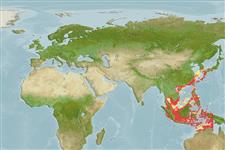
Berasosiasi dengan karang; payau; kisaran kedalaman 0 - 65 m (Acuan 111223). Tropical, preferred 26°C (Acuan 107945); 35°N - 15°S, 99°E - 137°E
Indo-West Pacific: from China, Japan and Korea to Philippines and westwards to the straits of Malaccca, also present in the Northern Territory, Australia. Tropical to subtropical.
Panjang pada saat jatuh tempo pertama / Ukuran / Berat / umur
Kematangan: Lm 6.5, range 6 - ? cm Max length : 20.0 cm CW jantan/; (Acuan 343)
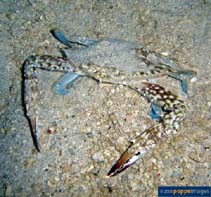
Carapace rough to granulose, regions discernible; front with 4 acutely triangular teeth; 9 teeth on each anterolateral margin, the last tooth 2 to 4 times larger than preceding teeth. Chelae elongate in males; larger chela with conical tooth at base of fingers; pollex ridged. Color: males with blue markings, females dull green.
Matures at about 1 year. Collected mainly by artisanal traps, trawls, beach seines, cylindrical wire traps, folding traps, pots, hop nets, drop nets, and sunken crab gill nets. In shallow waters, it is caught using beach seines, rakes, and dab nets. Sold in local markets (fresh or frozen) and for the crab-flesh canning industry. Most widely sold in markets of Southeast Asia, including the Philippines (Ref. 343). Maximum depth from Ref. 801. Immediate subtidal to a depth of 40 m (Ref. 801), on sandy to sandy-muddy substrates in areas near reefs, mangroves, and sea grass and algal beds (Ref. 343). Juveniles tend to occur in shallow intertidal areas (Ref. 343). Burrows in sand when disturbed; carnivorous and voracious predator (Ref. 801). Host to protozoans, helminths and crustaceans (Ref. 104981).
Members of the order Decapoda are mostly gonochoric. Mating behavior: Precopulatory courtship ritual is common (through olfactory and tactile cues); usually indirect sperm transfer.
rujukan utama
Acuan | Koordinator | mitra
Ng, P.K.L. 1998 Crabs. p. 1045-1155. In K.E. Carpenter and V.H. Niem (eds) FAO species identification guide for fishery purposes. The living marine resources of the Western Central Pacific. Volume 2. Cephalopods, crustaceans, holothurians and sharks. Rome, FAO. 1998. pp. 687-1396. (Acuan 343)
Status IUCN Red List
(Acuan 130435: Version 2025-2 (Global))
status CITES (Acuan 108899)
Not Evaluated
Not Evaluated
ancaman kepada manusia
Poisonous to eat (Acuan 130554)
penggunaan manusia
Perikanan: bernilai komersial tinggi
FAO - Aquaculture Systems: production searchPerikanan: profail spesis, landings search; Publication: search | FishSource | Laut di Sekitar Kita
Alat, peralatan
informasi lanjut
FisiologiKonsumsi oksigen
Yang berhubungan dengan manusiaPerangko, koin, dll.
Sumber internet
Estimasi berdasarkan model
Daya lenting
(Ref. 69278): |
Tinggi, Waktu penggandaan populasi minimum kurang dari 15 bulan (K=0.1-3.11) |
Rate of population increase
|
Prior r = 1.19, 95% CL = 0.78 - 1.78, Based on 22 data-limited stock assessments. |
Kerentanan Penangkapan Ikan
(Acuan 71543) |
Low vulnerability (10 of 100). |
Kerentanan Iklim
(Acuan 125649) |
Low to moderate vulnerability (34 of 100) |
kategori harga
(Acuan 80766): |
Very high. |
Nutrients
|
Calcium = 109 [35, 184] mg/100g; Iron = 1.59 [1.21, 1.97] mg/100g; Protein = 20.2 [19.2, 21.3] %; Omega3 = 0.285 [0.185, 0.386] g/100g; Selenium = 48.3 [-31.7, 128.3] μg/100g; VitaminA = 0 μg/100g; Zinc = 1.79 [1.17, 2.40] mg/100g (wet weight); based on nutrient studies. |