Hydrozoa |
Leptothecata |
Campanulariidae
Environnement : milieu / zone climatique / profondeur / gamme de distribution
Écologie
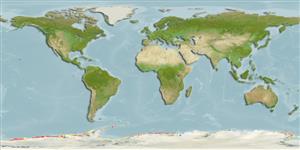
Démersal; profondeur 13 - 380 m (Réf. 7424). Polar
Circum-Antarctic.
Longueur à la première maturité / Taille / Poids / Âge
Maturité: Lm ? range ? - ? cm
Description synthétique
Morphologie
Stolonal hydrorhiza giving rise, by means of a short apophysis, to erect and slightly sinuous pedicels supporting a single hydrotheca resting on a basal spherule ca 4 cm high and 8.1 cm wide. Wall of pedicel smooth, but sometimes with a few distal annulations. Hydrotheca bell-shaped, ca 72.5 cm high, with a diaphragm (ca 11.3 cm wide) delimiting a small basal hamber (ca 6.4 cm high). Distinct inflexion point present between basal chamber and remaining part of hydrotheca. Hydrothecal diameter strongly increasing after basal chamber; thereafter almost
constant. Maximum diameter at aperture (ca 0.0435 cm). Hydrothecal aperture circular; rim provided with ca 12 blunt cusps, separated by shallow embayments.
Found at depths of 13 to 380 m on bottom of small rocks with red algae (Ref. 7424).
Cycle de vie et comportement reproducteur
Maturité | Reproduction | Frai | Œufs | Fécondité | Larves
Found colonies with gonothecae in June and August.
Peña Cantero, A.L., A. Svoboda and W. Vervoort 2004 Antarctic hydroids (Cnidaria, Hydrozoa) of the families Campanilinidae, Lafoeidae,and Campanulariidae from recent Antarctic expeditions with R.V. Polarstern, with description of a new species. Journal of Natural History 38:2269-2303. (Réf. 7424)
Statut dans la liste rouge de l'IUCN
(Réf. 130435: Version 2025-2 (Global))
statut CITES (Réf. 108899)
Not Evaluated
Not Evaluated
Menace pour l'homme
Harmless
Utilisations par l'homme
FAO - Publication: search | FishSource |
Outils
Plus d'informations
Écologie trophiqueAliments (proies)
Composition du régime alimentaire
Consommation alimentaire
Prédateurs
Dynamique des populationsCroissance
Âges / tailles maximales
Longueur-poids rel.
Rel. longueur-longueur.
Fréquences de longueurs
Conversion de masse
Abondance
Cycle de vieReproductionMaturitéFéconditéFraiŒufsDéveloppement de l'œufLarves PhysiologieConsommation d'oxygène
Liées à l'hommeTimbres, pièces de monnaie, divers
Sources Internet
Estimations basées sur des modèles
Vulnérabilité de la pêche
(Réf. 71543) |
(0 of 100). |