Hydrozoa |
Leptothecata |
Campanulariidae
Umwelt: Milieu / Klimazone / Tiefenbereich / Verbreitungsgebiet
Ökologie
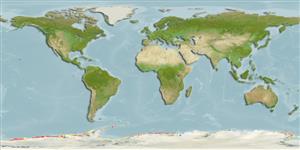
Demersal; tiefenbereich 13 - 380 m (Ref. 7424). Polar
Circum-Antarctic.
Länge bei der ersten Reifung / Größe / Gewicht / Alter
Geschlechtsreife: Lm ? range ? - ? cm
Stolonal hydrorhiza giving rise, by means of a short apophysis, to erect and slightly sinuous pedicels supporting a single hydrotheca resting on a basal spherule ca 4 cm high and 8.1 cm wide. Wall of pedicel smooth, but sometimes with a few distal annulations. Hydrotheca bell-shaped, ca 72.5 cm high, with a diaphragm (ca 11.3 cm wide) delimiting a small basal hamber (ca 6.4 cm high). Distinct inflexion point present between basal chamber and remaining part of hydrotheca. Hydrothecal diameter strongly increasing after basal chamber; thereafter almost
constant. Maximum diameter at aperture (ca 0.0435 cm). Hydrothecal aperture circular; rim provided with ca 12 blunt cusps, separated by shallow embayments.
Found at depths of 13 to 380 m on bottom of small rocks with red algae (Ref. 7424).
Lebenszyklus und Paarungsverhalten
Geschlechtsreife | Fortpflanzung | Ablaichen | Eier | Fruchtbarkeit | Larven
Found colonies with gonothecae in June and August.
Peña Cantero, A.L., A. Svoboda and W. Vervoort 2004 Antarctic hydroids (Cnidaria, Hydrozoa) of the families Campanilinidae, Lafoeidae,and Campanulariidae from recent Antarctic expeditions with R.V. Polarstern, with description of a new species. Journal of Natural History 38:2269-2303. (Ref. 7424)
IUCN Rote Liste Status
(Ref. 130435: Version 2025-2 (Global))
CITES Status (Ref. 108899)
Not Evaluated
Not Evaluated
Bedrohung für Menschen
Harmless
Nutzung durch Menschen
FAO - Publication: search | FishSource |
Tools
Mehr Information
Trophische ÖkologieLebensmittel (Beutetiere)
Nahrungszusammensetzung
Nahrungsaufnahme
Räuber
PopulationsdynamikWachstum
Max. Alter/Größen
Länge-Gewicht-Rel.
Länge-Länge-Verhältnis.
Längenhäufigkeiten
Massenkonvertierung
Dichte
LebenszyklusFortpflanzungGeschlechtsreifeFruchtbarkeitAblaichenEierEientwicklungLarven PhysiologieSauerstoffverbrauch
MenschenbezogenBriefmarken, Münzen, Verschiedenes.
Internet Quellen
Schätzungen auf der Grundlage von Modellen
Anfälligkeit der Fischerei
(Ref. 71543) |
(0 of 100). |