Malacostraca |
Stomatopoda |
Lysiosquillidae
Environnement : milieu / zone climatique / profondeur / gamme de distribution
Écologie
Benthic; profondeur 0 - 30 m (Réf. 436). Tropical
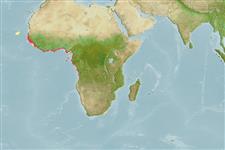
Off West Africa, from the Cape Verde Islands; Senegal to Angola.
Longueur à la première maturité / Taille / Poids / Âge
Maturité: Lm ? range ? - ? cm Max length : 27.0 cm BL mâle / non sexé; (Réf. 417); common length : 20.0 cm BL mâle / non sexé; (Réf. 436)
Description synthétique
Morphologie
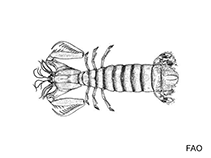
A moderately large to very large stomatopod. Body conspicuously flattened, smooth, lacking ridges or spines except for the tail region; 6th abdominal segment and telson; which is prickly with small bumps or tubercles. Telson with a raised, elongate boss medially, but without a median ridge. Rostral plate broader than long, with a low median crest on its anterior third. Claws very large, often longer than carapace and armed with 10 to 12 sharp spines on the terminal segment. Color: marked with light and dark cross bands (Ref. 436).
Found in shallow water (Ref. 436).
Cycle de vie et comportement reproducteur
Maturité | Reproduction | Frai | Œufs | Fécondité | Larves
Some members of the order Stomatopoda pair for life and some come together only to mate. Males produce sperm ducts rather than spermatophores; females can brood a maximum of 50,000 eggs. Life cycle: Eggs hatch to a planktonic zoea which lasts for 3 months.
Schneider, W. 1990 FAO species identification sheets for fishery purposes. Field guide to the commercial marine resources of the Gulf of Guinea. Prepared and published with the support of the FAO Regional Office for Africa. Rome: FAO. 268 p. (Réf. 417)
Statut dans la liste rouge de l'IUCN
(Réf. 130435: Version 2025-2 (Global))
statut CITES (Réf. 108899)
Not Evaluated
Not Evaluated
Menace pour l'homme
Harmless
Utilisations par l'homme
FAO - Publication: search | FishSource |
Outils
Plus d'informations
Écologie trophiqueAliments (proies)
Composition du régime alimentaire
Consommation alimentaire
Prédateurs
Dynamique des populationsCroissanceÂges / tailles maximalesLongueur-poids rel.Rel. longueur-longueur.Fréquences de longueursConversion de masseAbondance Cycle de vieReproductionMaturitéFéconditéFraiŒufsDéveloppement de l'œufLarves PhysiologieConsommation d'oxygène
Liées à l'hommeTimbres, pièces de monnaie, divers
Sources Internet
Estimations basées sur des modèles
Vulnérabilité de la pêche
(Réf. 71543) |
Low vulnerability (17 of 100). |
Catégorie de prix
(Réf. 80766): |
Unknown. |